Category Archives: M. Ed.

M. Ed. Videos

Conflict Management in Psychology

Conflict management in psychology refers to the process of resolving disagreements or disputes between individuals or groups in a constructive manner. It involves understanding the sources and nature of conflicts and employing strategies to prevent, manage or resolve conflicts.

Psychologists recognize that conflict is a natural and inevitable part of human interactions. It can arise from differences in values, goals, beliefs, personality, and culture. Conflict can also be caused by misunderstandings, communication breakdowns, or competing interests.

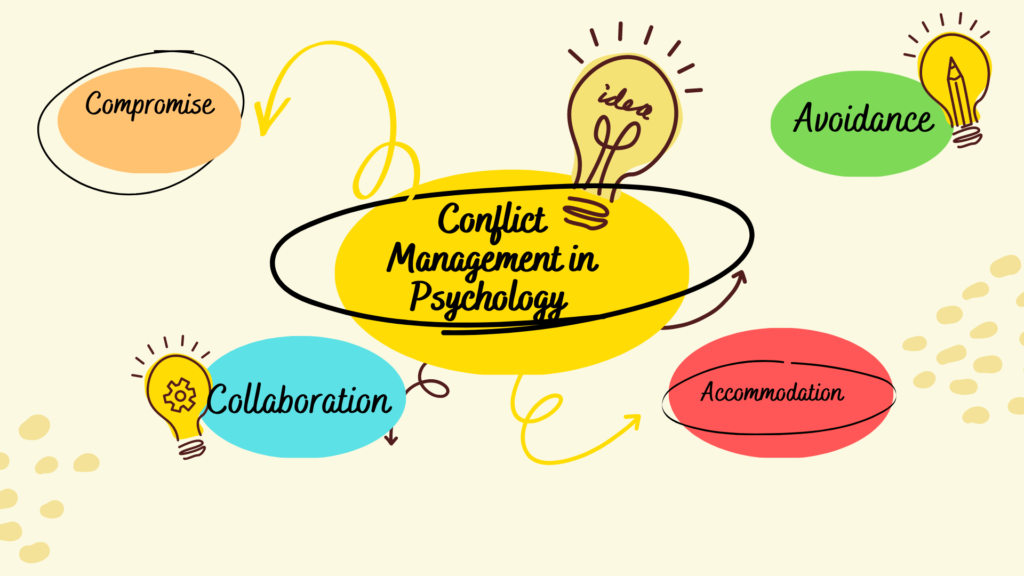
There are various approaches to conflict management in psychology. Some of the commonly used methods include:

  1. Collaborative problem-solving: This approach involves working together to identify the underlying issues and find mutually acceptable solutions.
  2. Compromise: In this approach, both parties make concessions and reach a middle ground that satisfies their interests.
  3. Avoidance: This approach involves ignoring or postponing the conflict until a later time when emotions are less intense.
  4. Accommodation: This approach involves one party giving in to the other to maintain harmony and preserve the relationship.
  5. Competitive: This approach involves seeking to win at all costs, which can lead to a win-lose situation.
Also read: Personality Assessment

Psychologists also emphasize the importance of effective communication, active listening, and empathy in conflict management. They may use techniques such as mediation, negotiation, or assertiveness training to help individuals or groups resolve conflicts. The ultimate goal of conflict management in psychology is to promote healthy relationships, enhance personal growth and reduce stress and negative emotions.

Also Visit: Prep with Harshita

Existentialism

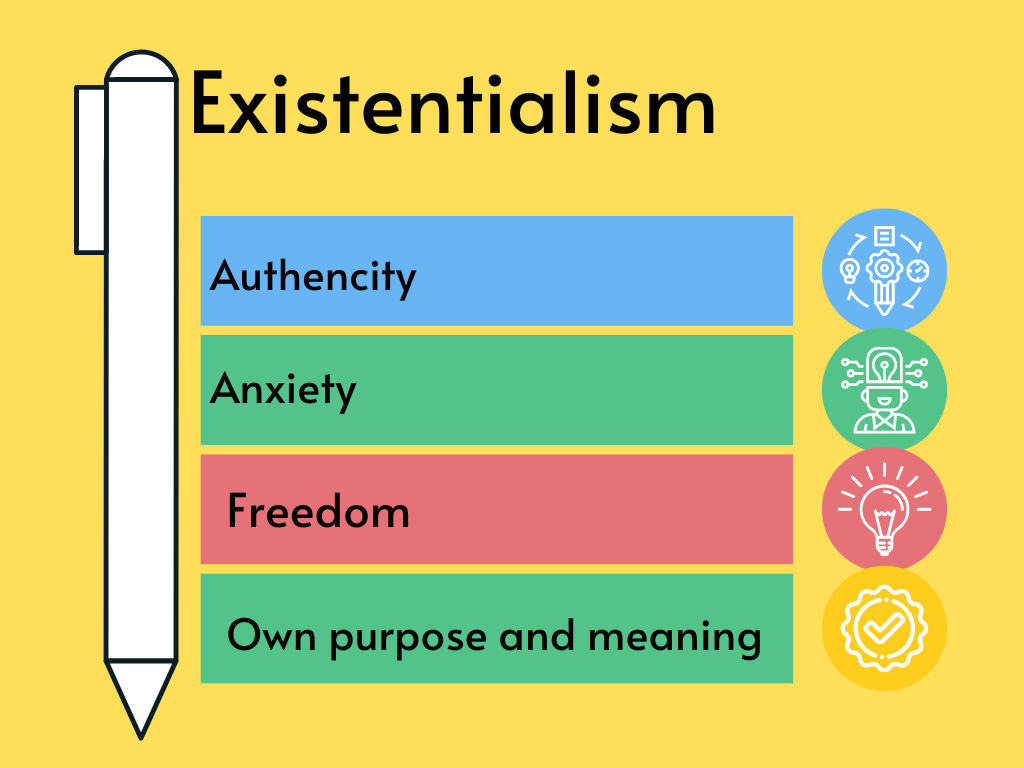
Existentialism is a philosophical and literary movement that emerged in Europe in the 20th century, particularly after World War II. It emphasizes individual freedom, authenticity, and choice.

At the heart of existentialism is the belief that individuals must create their own meaning and purpose in life, rather than relying on external factors such as religion or society. Existentialism emphasizes the importance of personal responsibility, as individuals are responsible for their own choices and actions.

Also read: Pragmatism

Some key themes in existentialism include:

  1. Authenticity: It stresses the importance of being true to oneself and one’s own values, rather than conforming to external expectations or societal norms.
  2. Freedom: Existentialism emphasizes the individual’s freedom to make choices and create their own path in life, even in the face of difficult or challenging circumstances.
  3. Anxiety: It recognizes that the freedom to make choices can also lead to anxiety and uncertainty, as individuals must take responsibility for their own lives and accept the consequences of their choices.
  4. Existential angst: The existentialist perspective often involves a sense of alienation or isolation from the world and a sense of despair or anxiety about the human condition.
  5. Existential crisis: It recognizes that individuals may experience a crisis of meaning or purpose, and must confront the question of whether life has any inherent meaning or value.

Overall, existentialism is a complex and multifaceted philosophy that emphasizes individual freedom, responsibility, and the creation of one’s own meaning and purpose in life. It has had a significant influence on literature, psychology, and other fields.

Also Visit: Prep with Harshita

Techniques of Manpower Forecasting

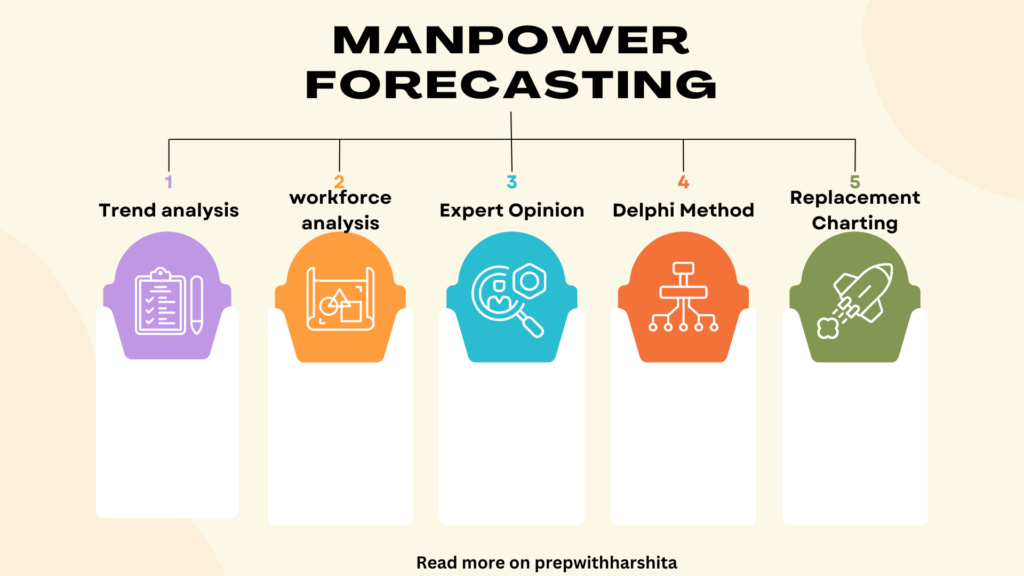
Manpower forecasting is the process of estimating the future workforce needs of an organization, based on a range of factors such as company growth projections, industry trends, and demographic changes. Here are some common techniques used for manpower forecasting:

  1. Trend analysis: This involves studying historical data on staffing levels, employee turnover rates, and other relevant factors to identify patterns and trends. This information can help in making predictions about future staffing needs.
  2. Workforce analytics: By analyzing employee data, such as performance ratings, skills, and demographics, organizations can identify gaps in the workforce and anticipate future hiring needs.
  3. Expert opinion: Gathering insights from managers and other subject matter experts can provide valuable information about industry trends and future business plans that can influence workforce needs.
  4. Workload analysis: Analyzing the workload and productivity levels of current employees can help determine if there is a need to hire additional staff or if current staff can be reallocated to more pressing needs.
  5. Scenario planning: This involves developing multiple scenarios based on various future scenarios, such as changes in technology or changes in the economy, to assess their impact on workforce needs.
  6. Replacement charting: This technique involves identifying critical positions within the organization and creating a list of potential candidates who could fill these roles in the future.
  7. Delphi method: This involves gathering expert opinions from a panel of industry experts anonymously, to ensure that personal biases do not influence the results.
Also Read: Cost Analysis in Education

Overall, the most effective manpower forecasting techniques will depend on the specific needs and goals of the organization, as well as the available data and resources.

Also Visit: Prep with Harshita

Inductive Method

An inductive method is a fundamental approach in science that involves making observations, collecting data, and drawing general conclusions based on the patterns observed.

In other words, the inductive method is used to formulate hypotheses and theories based on empirical observations.

Working of Inductive Method

The inductive method begins with observations of specific phenomena or data. Scientists then analyze the data, look for patterns or regularities, and formulate hypotheses or generalizations based on these patterns. These hypotheses are then tested through further observation and experimentation, and if they are supported by the evidence, they may be considered as scientific theories.

This is commonly used in the natural sciences, where scientists often rely on data collected through experiments or observations to formulate theories and explanations for natural phenomena. However, it can also be used in social sciences, where researchers often collect data through surveys or interviews to draw conclusions about human behavior or social patterns.

Also Read: Inductive and Deductive Approach
Uses of Inductive Method :
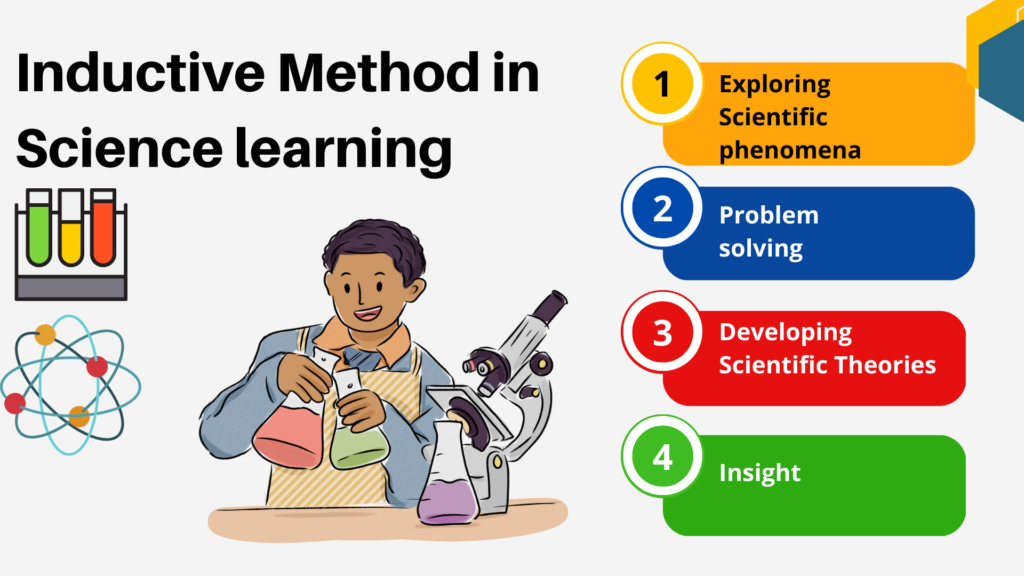
  1. Developing scientific theories: In the natural sciences, this is used to develop and refine theories by observing and analyzing data from experiments and observations. Scientists use this method to identify patterns in the data and develop hypotheses that can be tested through further experiments and observations.
  2. Exploring social phenomena: In the social sciences, the inductive method is used to explore social phenomena by collecting data through surveys, interviews, or observations. Researchers use the inductive method to identify patterns in the data and develop theories that can explain the observed phenomena.
  3. Generating new insights: This can be used to generate new insights and ideas in various fields of research, including humanities and arts. By observing and analyzing data, researchers can identify patterns and relationships that can lead to new theories, concepts, and perspectives.
  4. Problem-solving: This can be used to solve problems by observing and analyzing data related to the problem. By identifying patterns in the data, researchers can develop hypotheses and solutions that can be tested and refined through further observations and experiments.
  5. Formulating hypotheses: This also used to formulate hypotheses that can be tested through further research. By observing and analyzing data, researchers can identify patterns and relationships that can lead to new hypotheses and theories.

It is important to note that the inductive method does not necessarily lead to absolute or conclusive results. Rather, it is a process of continually refining and testing hypotheses based on new evidence and observations.

Inductive Method in Science Learning
Also Visit: Prep with Harshita

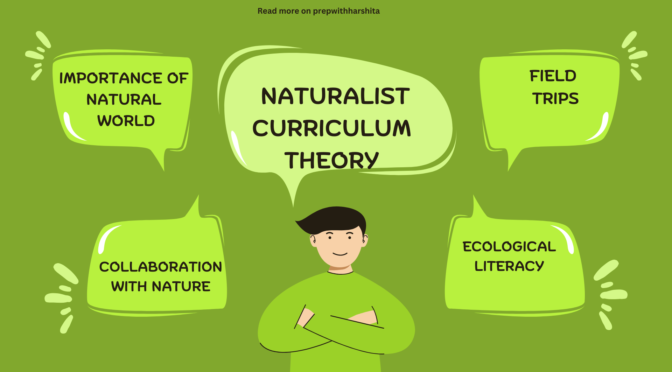
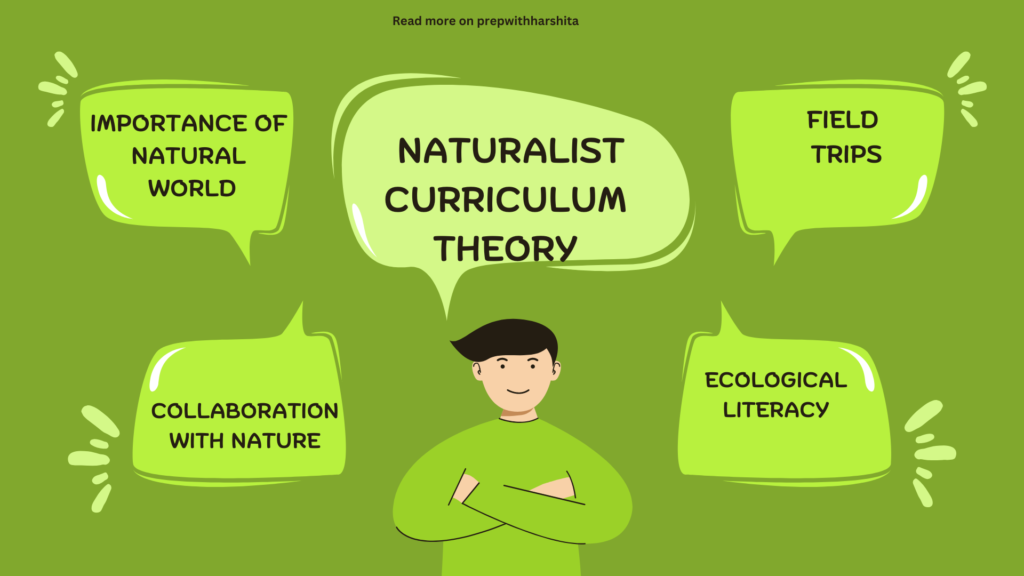
Naturalist Curriculum Theory

Naturalist curriculum theory is an educational approach that emphasizes the importance of connecting students with nature and the natural world.

Basis of this Theory :

The theory is based on the idea that humans have an innate connection to the environment, and that learning through direct experience in nature can be more meaningful and effective than traditional classroom instruction.

The naturalist curriculum theory focuses on creating learning opportunities that involve direct experiences with nature, such as outdoor exploration, field trips, and hands-on activities like gardening and nature observation.

Some of the key features of this theory include:

  1. Learning through direct experience: The naturalist curriculum theory emphasizes the importance of hands-on, experiential learning in natural environments. Students are encouraged to observe, explore, and interact with the natural world to gain a deeper understanding of the environment.
  2. Ecological literacy: The theory stresses the importance of ecological literacy, which includes understanding the interdependence of living things and the environment, and the impact of human actions on ecosystems. Students are taught to think critically about environmental issues and to develop a sense of responsibility for environmental stewardship.
  3. Emphasis on holistic learning: This theory focuses on the importance of holistic learning and integrating knowledge and skills from different subject areas and applying them to real-world situations. This approach promotes a deeper understanding of the interconnectedness of different disciplines and the relevance of learning to daily life.
  4. Connection to community: The theory emphasizes the importance of connecting students with their local communities and the natural environments. This can help students develop a sense of place and a connection to the natural world.
  5. Use of technology: While the naturalist curriculum theory emphasizes learning through direct experience in nature, it also acknowledges the importance of technology in modern society. Technology can be used to enhance learning and support scientific inquiry and exploration in natural environments.

Overall, this theory is one of several educational approaches that aim to promote experiential learning. It has been influential in shaping environmental education programs around the world.

Also read: Pragmatism
Also visit: Prep with Harshita