Tag Archives: mdu b ed

Team -Teaching

Team teaching is a collaborative teaching strategy in which two or more teachers work together to plan, teach, and evaluate a course or lesson. Team teaching can involve co-teaching a class or dividing teaching responsibilities between multiple teachers.

Some key features of team teaching include:

  1. Collaboration: It involves collaboration between teachers, who work together to plan and deliver instruction.
  2. Shared responsibility: In this, teachers share responsibility for instruction, assessment, and feedback. This can lead to more comprehensive and effective instruction.
  3. Diverse perspectives: It allows for the integration of diverse perspectives and expertise, which can enrich the learning experience for students.
  4. Increased student engagement: With multiple teachers, It can lead to increased student engagement and participation in class discussions and activities.
  5. Flexibility: It can be flexible and adaptable to meet the needs of different learners and teaching styles.
  6. More efficient use of resources: It can allow schools to make more efficient use of resources, by sharing teaching responsibilities and reducing class sizes.
Also read: Demonstration Method

Overall, this can be an effective teaching strategy, particularly for classes that require a range of expertise or involve a diverse group of learners. It can also promote collaboration among teachers and lead to more effective instruction and learning outcomes for students.

Also Visit: Prep with Harshita

Demonstration Method of Teaching

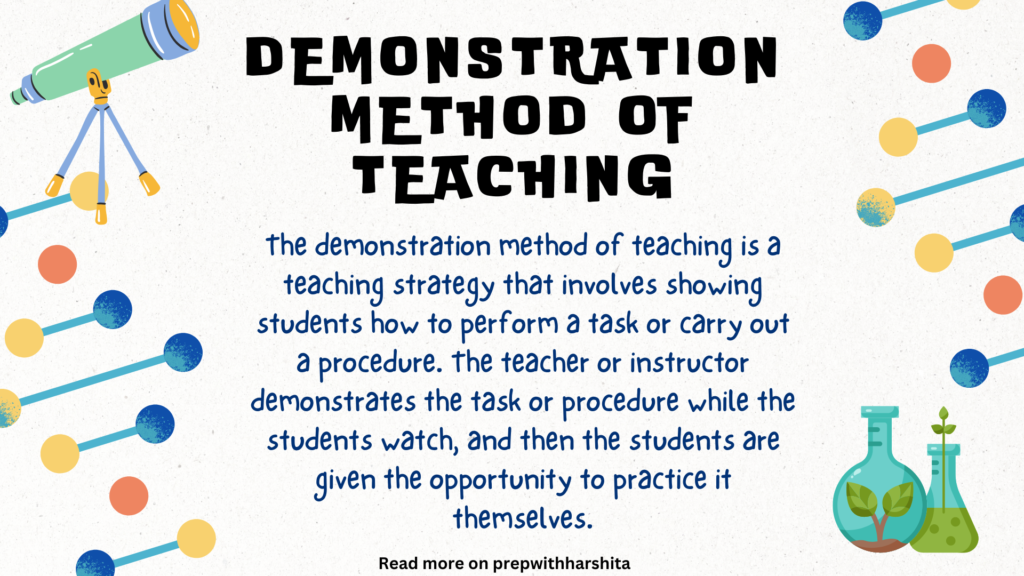
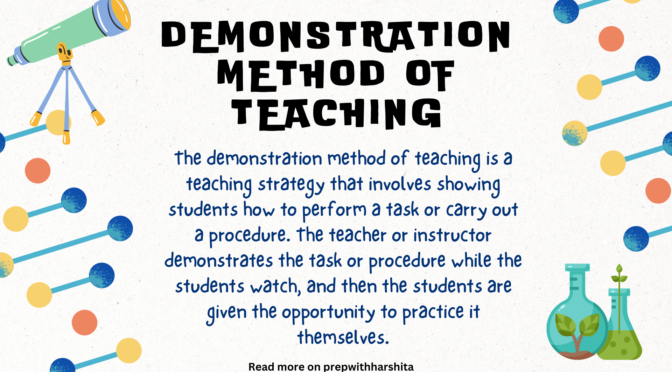
The demonstration method of teaching is a teaching strategy that involves showing students how to perform a task or carry out a procedure. The teacher or instructor demonstrates the task or procedure while the students watch, and then the students are given the opportunity to practice it themselves.

Some key features of the demonstration method of teaching include:

  1. Hands-on learning: The demonstration method provides students with a hands-on learning experience. By watching the teacher perform the task or procedure and then practicing it themselves, students can gain a deeper understanding of the material.
  2. Active participation: Students are actively engaged in the learning process when using the demonstration method.
  3. Visual learning: The demonstration method utilizes visual learning, as students can see the task or procedure being performed before attempting it themselves.
  4. Feedback: Students can receive immediate feedback from the teacher or instructor while practicing the task or procedure. They can correct any errors or misunderstandings.
  5. Real-world application: This method is used to teach practical skills that have real-world applications. This can be particularly useful in vocational or technical fields.
  6. Repetition: The demonstration method allows for repeated practice of a task or procedure until students feel comfortable and proficient.
Also read: Simulation Teaching Method

Overall, the demonstration method of teaching can be an effective way to teach practical skills and procedures. However, it may be less effective for teaching more abstract or theoretical concepts. This method can be combined with other teaching strategies, such as discussion or group work, to encourage a deeper understanding.

Demonstration Method of Teaching
Also Visit: Prep with Harshita

Simulation Teaching Method

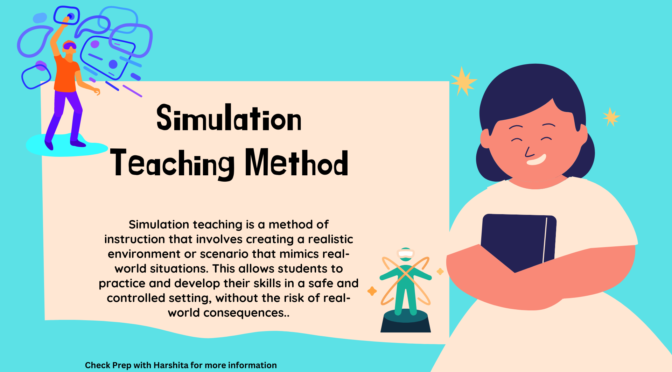
Simulation teaching is a method of instruction that involves creating a realistic environment or scenario that mimics real-world situations. This allows students to practice and develop their skills in a safe and controlled setting, without the risk of real-world consequences.

Simulation teaching is commonly used in fields such as healthcare, aviation, and military training. For example, in healthcare, simulation teaching can involve using lifelike mannequins or virtual reality technology to simulate medical emergencies and procedures.

Read more: Curriculum Construction

Simulation teaching typically follows a structured process, which includes the following steps:

  1. Pre-briefing: The instructor provides an overview of the scenario and outlines the learning objectives.
  2. Scenario: The simulation is carried out, with the students participating in the role-play.
  3. Debriefing: After the simulation, the instructor facilitates a discussion with the students to reflect on their experiences, identify areas for improvement, and reinforce key learning points.

Simulation teaching can be highly effective in helping students develop practical skills and apply theoretical knowledge in a realistic context. It can also be a useful tool for assessing student performance and identifying areas for improvement.

Some key features of Simulation include :

  1. Realistic scenarios: Simulation teaching involves creating realistic scenarios that mimic real-world situations. This allows students to apply their knowledge and skills in a safe and controlled environment, without the risk of real-world consequences.
  2. Active participation: Simulation teaching encourages active participation by students. They take on roles and perform tasks within the simulated environment, which helps to increase engagement and retention.
  3. Feedback: Simulation teaching provides immediate feedback to students. Instructors can observe and evaluate student performance during the simulation, and provide feedback to help them improve.
  4. Repetition: Simulation teaching allows for repeated practice of skills and tasks. This can help students to develop proficiency and confidence in their abilities.
Simulation Teaching Method
Also Visit: Prep with Harshita

Inductive Method

An inductive method is a fundamental approach in science that involves making observations, collecting data, and drawing general conclusions based on the patterns observed.

In other words, the inductive method is used to formulate hypotheses and theories based on empirical observations.

Working of Inductive Method

The inductive method begins with observations of specific phenomena or data. Scientists then analyze the data, look for patterns or regularities, and formulate hypotheses or generalizations based on these patterns. These hypotheses are then tested through further observation and experimentation, and if they are supported by the evidence, they may be considered as scientific theories.

This is commonly used in the natural sciences, where scientists often rely on data collected through experiments or observations to formulate theories and explanations for natural phenomena. However, it can also be used in social sciences, where researchers often collect data through surveys or interviews to draw conclusions about human behavior or social patterns.

Also Read: Inductive and Deductive Approach
Uses of Inductive Method :
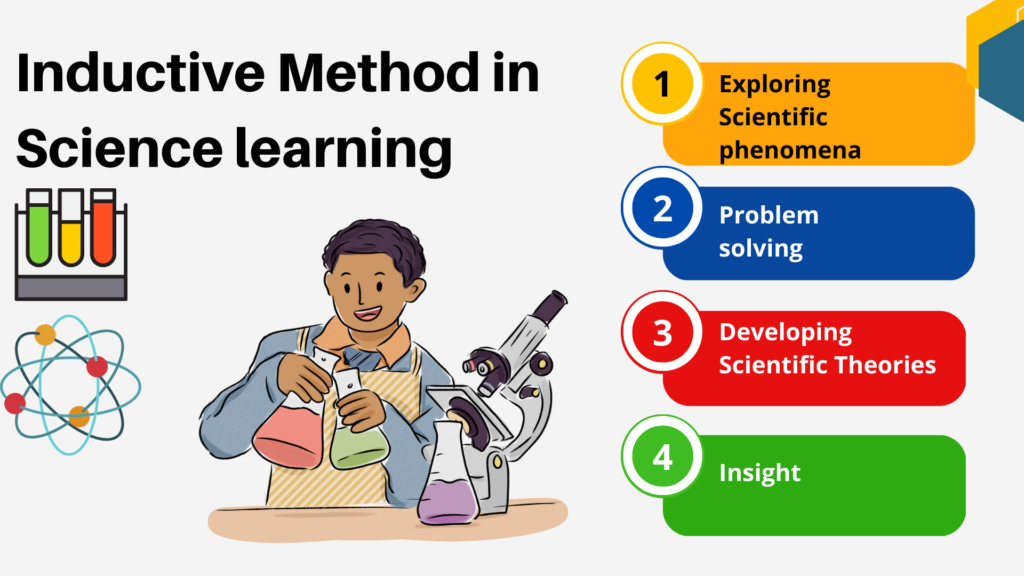
  1. Developing scientific theories: In the natural sciences, this is used to develop and refine theories by observing and analyzing data from experiments and observations. Scientists use this method to identify patterns in the data and develop hypotheses that can be tested through further experiments and observations.
  2. Exploring social phenomena: In the social sciences, the inductive method is used to explore social phenomena by collecting data through surveys, interviews, or observations. Researchers use the inductive method to identify patterns in the data and develop theories that can explain the observed phenomena.
  3. Generating new insights: This can be used to generate new insights and ideas in various fields of research, including humanities and arts. By observing and analyzing data, researchers can identify patterns and relationships that can lead to new theories, concepts, and perspectives.
  4. Problem-solving: This can be used to solve problems by observing and analyzing data related to the problem. By identifying patterns in the data, researchers can develop hypotheses and solutions that can be tested and refined through further observations and experiments.
  5. Formulating hypotheses: This also used to formulate hypotheses that can be tested through further research. By observing and analyzing data, researchers can identify patterns and relationships that can lead to new hypotheses and theories.

It is important to note that the inductive method does not necessarily lead to absolute or conclusive results. Rather, it is a process of continually refining and testing hypotheses based on new evidence and observations.

Inductive Method in Science Learning
Also Visit: Prep with Harshita

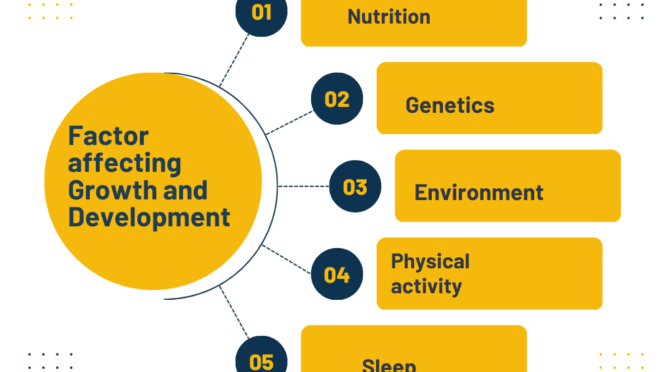
Factors affecting Growth and Development

There are numerous factors that can affect growth and development like Genetics and environment.

A few of them are mentioned below:
  1. Genetics: Hereditary factors can determine physical characteristics and predispositions to certain health conditions.
  2. Environment: The physical, social, and cultural environment in which a person grows up can have a significant impact on their development.
  3. Nutrition: Adequate nutrition is crucial for healthy growth and development, as it provides the necessary nutrients for the body to grow and function properly.
  4. Hormones: Hormones play a critical role in growth and development, including puberty and reproductive development.
  5. Physical activity: Regular exercise and physical activity can help promote healthy growth and development, as well as overall health and well-being.
  6. Sleep: Adequate sleep is important for growth and development, as it allows the body to repair and regenerate tissues.
  7. Medical conditions: Certain medical conditions, such as chronic illnesses, infections, or injuries, can affect growth and development.
  8. Parental factors: Parental behavior, including parenting style, discipline, and involvement, can have a significant impact on a child’s development.
  9. Socioeconomic status: Socioeconomic status can affect access to resources, such as education and healthcare, that can impact growth and development.
  10. Cultural factors: Cultural beliefs and values can influence growth and development, particularly in terms of socialization and identity formation.

Growth refers to the physical changes that occur in a child’s body, such as increases in height, weight, and the size of organs and bones.

Development, on the other hand, refers to the broader changes in a child’s cognitive, emotional, social, and behavioral skills and abilities.

Factors affecting growth and development are including genetics, nutrition, physical activity, environment, and social and emotional experiences.

Also read: Parenting Styles
Factor affecting growth and Development
Also Visit: Prep with Harshita