Tag Archives: mdu b ed

Kothari Commission

The Kothari Commission, also known as the Education Commission of 1964-66, was a high-level committee set up by the Government of India in 1964 to examine all aspects of the education sector in India and to provide recommendations for its improvement. The commission was headed by D. S. Kothari, an eminent educationist, and had several other members, including academicians, policymakers, and administrators.

Main Focus of the Kothari Commission

The main point of the Kothari Commission was to study the issues related to education in India and provide recommendations for its improvement. The commission’s report, submitted in 1966, identified several key challenges facing the education sector in India, such as low levels of literacy, inadequate access to education, poor quality of education, and the lack of relevance of education to the needs of society and the economy.

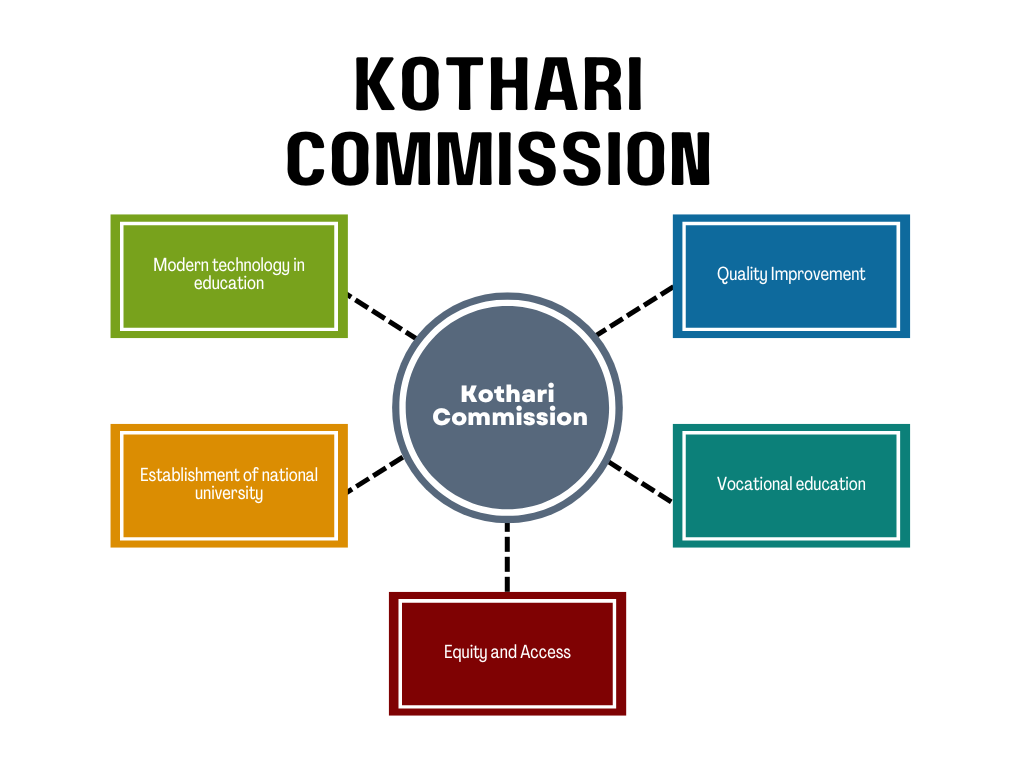
The Kothari Commission’s report, submitted in 1966, provided a comprehensive analysis of the state of education in India, identified the key challenges, and made recommendations for reforms. The recommendations covered a broad range of issues like

  1. The expansion of educational opportunities
  2. The improvement of the quality of education
  3. The establishment of national universities
  4. The introduction of vocational education
  5. The universalization of elementary education
  6. The use of modern technology in education.

The Kothari Commission’s recommendations have been the basis for many education policies and programs in India since their release, and the commission’s report is considered a seminal document in the history of education in India.

The commission’s recommendations were aimed at creating a more equitable, relevant, and efficient education system that would contribute to the overall development of the country. The Kothari Commission’s report has had a significant influence on the education policies and programs in India since its release, and its recommendations continue to shape the education system in the country today.

The Kothari Commission, also known as the Education Commission of 1964-66, had several features that were distinctive and significant in the context of education in India. Some of the main features of the Kothari Commission are:

  1. Comprehensive approach: The Kothari Commission had a comprehensive approach to studying the education system in India. It examined all aspects of education, from elementary education to higher education, and considered the social, economic, and cultural factors that influenced education.
  2. Holistic vision: The Commission had a holistic vision of education that emphasized the development of the whole person, including the intellectual, social, emotional, and moral dimensions of education.
  3. Equity and access: The Commission recognized the importance of equity and access in education and recommended measures to ensure that all segments of society had access to quality education.
  4. Quality improvement: The Commission emphasized the need to improve the quality of education in India and made recommendations for improving teacher training, curriculum development, and educational technology.
  5. Vocational education: The Commission recognized the importance of vocational education in preparing students for employment and recommended the introduction of vocational education at various levels of education.
  6. National universities: The Commission recommended the establishment of national universities to promote excellence in higher education and research.
  7. Elementary education: The Commission emphasized the need to universalize elementary education and recommended measures.

Also Read: Behavioristic Theory of learning
Check the Youtube Channel: Prep with Harshita
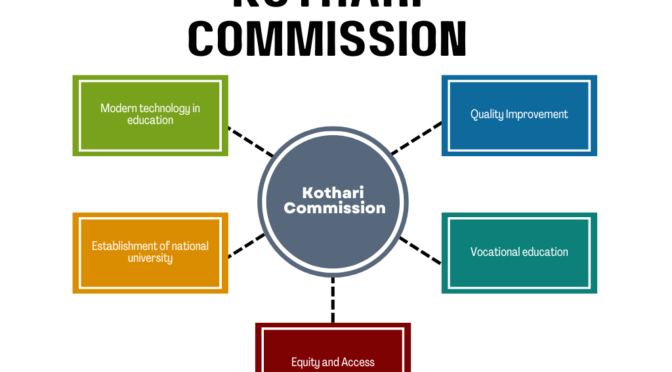
Kothari Commission

Principles of Curriculum Construction

The principles of curriculum construction are the underlying guidelines that affect the development and design of a curriculum. These principles serve as a framework to ensure that the curriculum is effective, relevant, and meaningful to the learners.

Some of the key principles of curriculum construction include:

  1. Alignment with learning goals: The curriculum should be aligned with specific learning goals that are relevant and meaningful to the learners. These goals should be well-informed and communicated to the learners and teachers.
  2. Relevance and authenticity: The curriculum should be relevant and authentic to the learners’ lives and experiences. It should be designed to connect with the learners’ interests, culture, and background.
  3. Flexibility and adaptability: The curriculum should be flexible and adaptable to meet the changing needs and interests of the learners. It should be designed to accommodate different learning styles and preferences.
  4. Collaboration and participation: The curriculum should encourage collaboration and participation among learners, teachers, and other stakeholders. It should provide opportunities for learners to take an active role in their own learning and contribute to the design and development of the curriculum.
  5. Continuous improvement: The curriculum should be continuously evaluated and improved based on feedback from learners, teachers, and other stakeholders. This process should be ongoing and dynamic and should aim to improve the effectiveness and relevance of the curriculum.
  6. Integration of technology: The curriculum should be designed to integrate technology effectively to enhance learning outcomes. This includes the use of digital resources, online platforms, and other forms of technology to support and enhance the learning experience.

Overall, the principles of curriculum construction aim to ensure that the curriculum is relevant, meaningful, and effective in achieving specific learning goals. These principles emphasize the importance of alignment, relevance, flexibility, collaboration, continuous improvement, and the integration of technology to create a dynamic and effective curriculum.

Also Read : Role of Teacher as Curriculum Maker

Principle of Curriculum Construction

Also Visit : Prep with Harshita

Curriculum as Process

The curriculum as process perspective views the curriculum as a dynamic and ongoing process of learning that is co-created by teachers and students and keeps on changing. This approach emphasizes the importance of considering the individual needs, interests, and experiences of students, and adapting the curriculum to meet their unique learning needs.

Some of the key features of the curriculum from a process perspective include:

  1. Flexibility: The curriculum as a process approach is designed to be flexible and adaptable to the needs and interests of students. This allows teachers to modify the curriculum to the individual needs of their students and to incorporate their ideas and thoughts.
  2. Collaborative learning: Curriculum as a process involves collaborative learning, where teachers and students work together to develop and shape the curriculum. This approach focuses on the importance of students taking an active role in their own learning and working collaboratively with their peers.
  3. Inquiry-based learning: The approach encourages inquiry-based learning, where students are encouraged to ask questions, explore their interests, and engage in critical thinking. This approach focuses on the importance of developing students’ higher-order thinking skills and creativity.
  4. Reflection: It involves reflection, where students and teachers reflect on their learning and the curriculum as a whole. This approach encourages students to be self-aware and to take ownership of their learning, while also providing opportunities for teachers to evaluate the effectiveness of the curriculum.
  5. Continuous improvement: The approach focuses on the importance of continuous improvement, where teachers and students work together to identify areas of strength and weakness in the curriculum and make changes as needed to improve the learning experience.

This approach values flexibility, collaboration, inquiry-based learning, reflection, and continuous improvement, and encourages teachers to adapt the curriculum to the changing needs and interests of their students.

Also Read : Tyler Model

Also Visit : Prep with Harshita

Curriculum as Product

In the context of curriculum as product and education, the curriculum can be viewed as a product. A curriculum can be seen as a designed and packaged set of educational experiences, learning goals, and materials that are delivered to students in a specific sequence or order.

The product perspective of curriculum views it as a pre-determined set of educational goals and objectives, organized into a structured program or course of study.

The product perspective of the curriculum is often associated with a top-down, centralized approach to education, where decisions about what should be taught, how it should be taught, and how it should be assessed are made by curriculum designers and policymakers. This approach has been criticized for being too focused on outcomes and not taking into account the diversity of students’ backgrounds, interests, and learning styles.

Overall, the product perspective of the curriculum emphasizes the importance of defining clear learning outcomes, creating effective instructional materials, and assessing students’ progress toward meeting those outcomes. However, it should be complemented with other perspectives, such as the learner-centered and socio-cultural perspectives, to ensure that education is tailored to the needs and interests of all students.

The product perspective of curriculum sees it as a set of planned and organized educational experiences that are designed to achieve specific learning outcomes. Some of the key features of the curriculum as a product perspective include:

  1. Standardization : It is designed to be standardized across different classrooms, schools, and districts. This approach aims to ensure that all students are exposed to the same content and skills, regardless of their location or background.
  2. Learning objectives: The approach places a strong emphasis on defining clear learning objectives and outcomes. These objectives serve as the basis for developing instructional materials, assessments, and evaluations.
  3. Structured content: This approach typically involves a structured sequence of content and skills that students are expected to master. This sequence is often predetermined and follows a logical progression that builds on previous knowledge and skills.
  4. Assessment: The requires a systematic and standardized approach to assessing students’ progress toward meeting learning objectives. This may involve standardized tests, exams, or other forms of assessment.
  5. Instructional materials: This approach emphasizes the development of high-quality instructional materials, such as textbooks, workbooks, and other resources. These materials are designed to support teachers in delivering the curriculum and ensuring that students meet the learning objectives.

Also Read : School and Out of School

Curriculum as Product

Also Read : Prep with Harshita

Major characteristics of Curriculum Theory- Conceptual Structure

The conceptual structure of curriculum theory includes the following major characteristics:

  1. Curriculum as a social construct: Curriculum theory views curriculum as a socially constructed structure that is shaped by the values, beliefs, and relations of society. It recognizes that curriculum is not a neutral organization or structure but is influenced by social and cultural contexts.
  2. Curriculum as a process: Curriculum theory views curriculum as a dynamic and ongoing process that involves the design, implementation, and evaluation of educational programs. It recognizes that curriculum is not a fixed entity but is constantly evolving and changing in response to new knowledge, social and cultural changes, and educational policies.
  3. Curriculum as a context for learning: Curriculum theory views curriculum as a context for learning, in which learners engage in meaningful and purposeful activities that promote their intellectual, social, and emotional development. It recognizes that curriculum is not just a collection of knowledge and skills but is a means for promoting the holistic development of learners.
  4. Curriculum as a tool for social change: Curriculum theory views curriculum as a tool for social change, in which educators can use the curriculum to promote social justice, equity, and democracy. It recognizes that curriculum can be used to challenge social inequalities and to promote the empowerment of learners.
  5. Curriculum as a reflection of values and beliefs: Curriculum theory views curriculum as a reflection of the values and beliefs that underlie education. It recognizes that curriculum is not value-free but is shaped by the beliefs and values of educators, learners, and society.
Major Characteristics of Curriculum Theory- Conceptual Structure