Tag Archives: mdu b ed

Nicholls and Nicholls Model of Curriculum Development

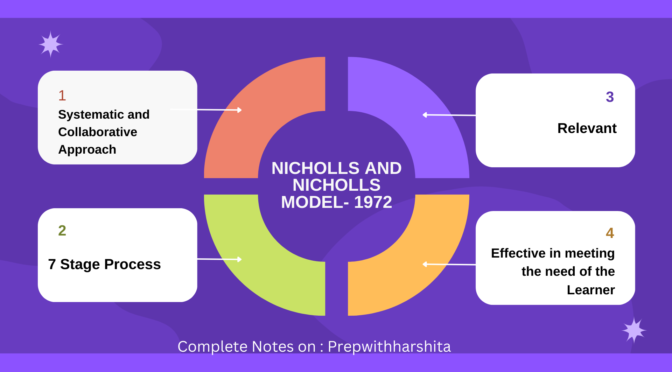
The Nicholls and Nicholls Model of Curriculum Development 1972 model emphasizes the importance of a systematic and collaborative approach to curriculum development. It highlights the need to identify the needs and goals of the learners and the community, select appropriate content and teaching methods, and continuously evaluate and revise the curriculum to ensure it remains effective and relevant.

This Model of Curriculum Development is a systematic approach to curriculum development that was developed by John Nicholls and Sheelah Nicholls. The model outlines a seven-stage process for developing a curriculum that is relevant and effective in meeting the needs of the learners and the community.

Also Visit: Prep with Harshita

The Model is a 7-stage model that outlines a systematic approach to curriculum development. The seven stages are:

  1. Focus on the educational problem: The first stage involves identifying and defining the educational problem or need. This stage involves conducting a thorough analysis of the situation and identifying the needs of the learners and the community.
  2. Formulation of the curriculum objectives: The second stage involves formulating the curriculum objectives that are based on the identified needs and goals. These objectives should be specific, measurable, achievable, relevant, and time-bound.
  3. Selection of the content: The third stage involves selecting the appropriate content that aligns with the curriculum objectives. This content should be relevant, current, and applicable to the learners’ needs.
  4. Organization of the content: The fourth stage involves organizing the selected content into a coherent and logical sequence. This stage involves developing a structure for the curriculum that is easy to follow and understand.
  5. Selection of teaching methods: The fifth stage involves selecting the appropriate teaching methods. The strategies should align with the curriculum objectives and content. These methods should be engaging, interactive, and effective in achieving the desired learning outcomes.
  6. Evaluation of the curriculum: The sixth stage involves evaluating the effectiveness of the curriculum in achieving the desired learning outcomes. This stage involves collecting and analyzing data to determine whether the curriculum objectives have been met.
  7. Revision of the curriculum: The final stage involves revising the curriculum based on the evaluation results. This stage involves making necessary adjustments and improvements to ensure the curriculum remains relevant and effective.
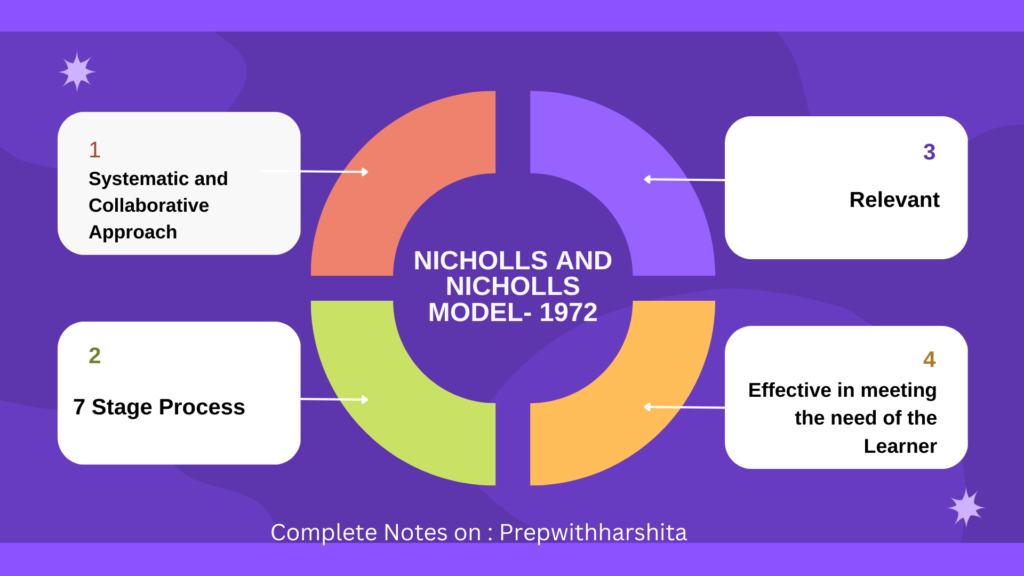
Nicholls and Nicholls Model -1972 | Curriculum Development Model
Also Read: Hilda Taba Model of Curriculum Development

Multilingual Approach to Language Teaching

A multilingual approach to language teaching understands the value of using multiple languages in the classroom to support language learning and promote linguistic and cultural diversity. This approach can be particularly beneficial for students who are learning a second or foreign language, as it allows them to draw on their existing linguistic and cultural knowledge which can help them in the acquisition of a new language.

A multilingual approach to language learning is an approach that recognizes the value of using multiple languages in the language-learning process. This approach recognizes the diversity of linguistic and cultural backgrounds of learners and aims to use this diversity as a resource to support language acquisition and understanding.

Also Read: Constructive Approach to Language Teaching

Features of Multilingual Approach to Language Teaching:

  1. Embrace linguistic and cultural diversity: A multilingual approach recognizes that students come from a variety of linguistic and cultural backgrounds and that this diversity can enrich the language learning experience. Teachers should embrace this diversity and create a classroom environment that values and celebrates different languages and cultures.
  2. Use students’ native languages as a resource: Teachers can use students’ native languages as a resource to support language learning. For example, they can encourage students to make connections between their native language and the target language, or they can use translation exercises to help students understand new vocabulary or grammar concepts.
  3. Integrate multiple languages into the curriculum: A multilingual approach involves integrating multiple languages into the curriculum in meaningful ways. For example, teachers can use authentic materials in different languages, such as literature or media, to expose students to a variety of languages and cultures.
  4. Provide language-rich environments: Teachers should create language-rich environments that promote active language use and engagement. This can involve using a variety of instructional strategies, such as group work, pair work, and interactive activities, to encourage students to use multiple languages in meaningful ways.
  5. Promote intercultural competence: A multilingual approach should also aim to promote intercultural competence, or the ability to communicate effectively and appropriately with people from different cultures. Teachers can use a variety of activities and materials, such as cultural exchanges, to promote intercultural understanding and respect.
Multilingual Approach To Language Teaching
Also Visit: Prep with Harshita

Constructive Approach to Language Teaching

A constructive approach to language teaching is a method that emphasizes active and engaged learning, focusing on the learner’s ability to construct meaning and knowledge through personal experiences and interactions with the language. It is a learner-centered approach that encourages learners to take an active role in their learning process, rather than passively receiving information.

In a constructive approach to language teaching, learners are encouraged to experiment with the language, make mistakes, and learn from those mistakes. The approach focuses on the importance of meaningful communication, encouraging learners to use the language in real-life situations and focusing on understanding rather than memorization.

The constructive approach also emphasizes the importance of collaboration and interaction. Learners are encouraged to work together in pairs or small groups, practicing speaking, listening, reading, and writing in a supportive environment which can help them to learn in a better constructive way.

Also Read: Multilingual Approach to Language Teaching

Features of Constructive Approach :

  1. Learner autonomy: In a constructive approach, learners take responsibility for their learning, setting their own goals and working at their own pace.
  2. Personalized learning: The approach is personalized to the individual learner’s needs, interests, and learning style, providing opportunities for learners to explore and experiment with the language in a way that is meaningful to them.
  3. Collaborative learning: Collaboration and interaction are focused, which helps learners to work together. They also learn from each other’s experiences and perspectives.
  4. Active engagement: Learners are actively engaged in the learning process, making meaning through personal experiences and interactions with the language.
  5. Focus on meaning: The approach shows the importance of understanding and meaningful communication, rather than just memorizing rules and vocabulary.
  6. Feedback and reflection: Feedback and reflection are important parts of the learning process, allowing learners to monitor their progress, identify areas for improvement, and make adjustments to their learning strategies.
Constructive Approach to Language Teaching
Also Visit: Prep with Harshita

Types of Motivation

Motivation refers to the internal or external factors that drive a person to take action toward achieving a goal or fulfilling a need. It is the force that propels an individual to act, whether it is to complete a task, pursue a goal, or engage in a behavior.

Motivation is an important aspect of human behavior as it determines the level of effort, persistence, and determination a person will put into achieving a goal. It is also essential for personal and professional growth, as it helps individuals overcome challenges, adapt to changes, and achieve their full potential.

Also Read: Motivation Cycle

Types of Motivation :

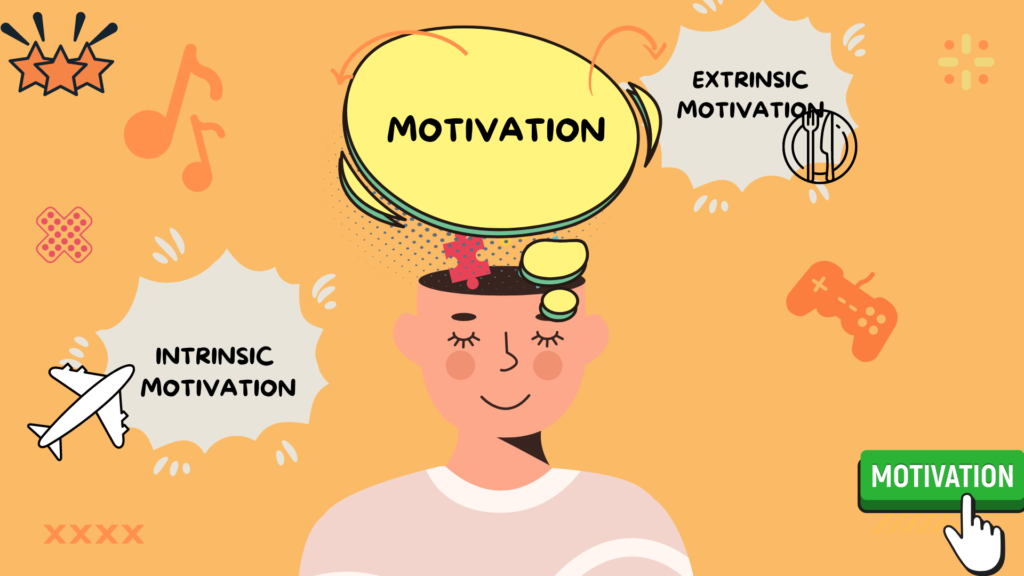
  • Intrinsic motivation: It is the type of motivation that comes from within oneself. It is driven by personal satisfaction, interest, and enjoyment. Examples include pursuing a hobby, learning a new skill for personal growth, or doing something simply because it is enjoyable.
  • Examples of intrinsic motivation include pursuing a hobby, learning a new skill , or doing something simply because it is enjoyable. Intrinsic motivation is often associated with positive emotions and a sense of personal fulfillment and satisfaction.
  • Intrinsic motivation is generally more effective in promoting long-term behavior change and personal growth compared to extrinsic motivation. When individuals are intrinsically motivated, they are more likely to persist in their efforts. They become creative and innovative in finding solutions to problems.
  • Extrinsic motivation: This type of motivation comes from external factors like rewards, recognition, or consequences. It is driven by external factors and not by personal satisfaction or interest. Examples include working for a salary, studying for good grades, or doing a task to avoid punishment.
  • Examples of extrinsic motivation include working for a salary, studying for good grades, or doing a task to avoid punishment. Extrinsic motivation is related to external pressure or expectations, and may not necessarily reflect an individual’s personal interests or desires.
  • Extrinsic motivation may be effective in promoting short-term behavior change but causes decreased motivation over time if the external rewards are removed. Individuals may become less interested in the activity or goal once the external reward is no longer available.
Types of Motivation
Also Visit: Prep with Harshita

Defense Mechanisms in Psychology

In psychology, defense mechanisms are unconscious psychological strategies that people use to protect themselves from feelings of anxiety, guilt, or shame.

What is Defense Mechanism?

Defense mechanisms operate at an unconscious level and help people avoid unpleasant emotions by distorting or denying reality.

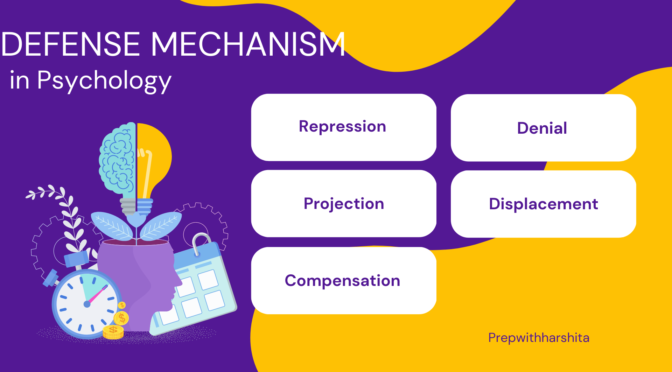
Some common Defense mechanisms in Psychology are:

  1. Repression: Keeping unpleasant memories or thoughts out of conscious awareness. In case a person sees the accidental sudden demise of a beloved friend or family member, this painful experience may be excluded from his conscious self leading him to become amnesic to this experience.
  2. Denial: Refusing to acknowledge or accept the reality of a situation. In this, the person ignores or refuses to acknowledge reality which is not acceptable or agreeable to him. If a person is feeling the stress of an unpleasant topic he, may turn away from that
  3. Projection: Attributing one’s own negative thoughts, feelings, or impulses to others. In projection, people blame others for one’s own shortcoming, mistakes, misdeed, unacceptable impulses, thoughts and desires. Projection is a tendency being observed in human behavior for ego protection.
  4. Displacement: Redirecting emotions from their original source to a less threatening target. In displacement the person shifts his feelings of hostility and anxiety from the person who is the real cause to another person. Displacement is a way out in difficult emotional situations.
  5. Regression: Reverting to immature behavior or earlier patterns of coping in response to stress.
  6. Regression is a defense mechanism in which one performs reverted behavior. The decline in attention of parents towards an elder child due to a new addition to the family may result in the elder one reverting to bed wetting and other infantile behavior to draw parental attention.
  7. Rationalization: Justifying one’s behavior with logical explanations that disguise the real, unconscious motives. While using rationalization mechanism one thinks logically and offers socially approved reasons in order to justify one’s behavior. Though one knows that his action is immoral and unreasonable.
  8. Identification: Modeling one’s behavior and thoughts after another person as a way of coping with anxiety. Identification may operate as a defense mechanism by increasing feelings of worth and protecting the individual against self devaluation
  9. Introjection: Taking in and internalizing the values, attitudes, or beliefs of others to the point where they become a part of one’s own self-concept. Introjection as a defence mechanism involves the acceptance of the other’s values and norms as one’s own even when they are the opposite of one’s previous assumptions.
  10. Compensation: Counterbalancing perceived weaknesses or shortcomings by emphasizing or exaggerating one’s strengths in other areas. People make an effort to draw attention away from a defect or a weakness.
Also Visit: Prep with Harshita

These defense mechanisms are not inherently good or bad, but they can become problematic if they are used excessively or inappropriately and prevent people from facing and addressing their problems in a healthy and productive way.

Defense Mechanism in Psychology
Also Read: Conflict Management in Psychology