Deconstructive Theory on Gender

Deconstructive theory on gender is a theoretical framework that aims to question and challenge the binary understanding of gender, which posits that there are only two distinct and fixed gender categories: male and female.

  • This theory seeks to deconstruct and challenge the traditional assumptions and meanings associated with gender, including the social, cultural, and political constructs that shape gender identity.
  • Deconstructive theory on gender is rooted in postmodernism and draws from the work of French philosopher Jacques Derrida, who proposed that language is not fixed and stable but rather is a constantly shifting and evolving system of signs and symbols. According to deconstructive theory on gender, gender is a social construct that is not fixed or stable but rather is a product of discourse and cultural practices.
  • Deconstructive theory on gender challenges the idea that gender is determined by biological sex, and instead suggests that gender is a performance or a social role that is constructed through social interactions and language.
  • This theory argues that gender is not a natural or innate category but rather is a social construct that is created and maintained through cultural practices, norms, and power dynamics.

Features of Deconstructive Theory:

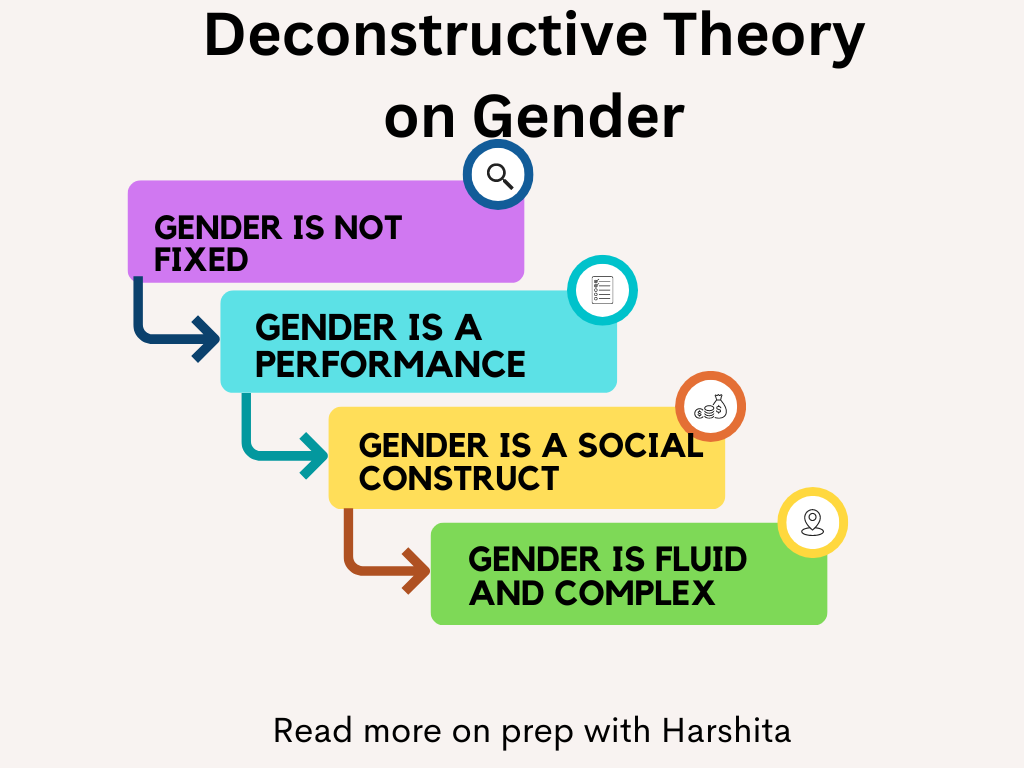
  1. Gender is not a fixed or stable category: According to deconstructive theory on gender, gender is not an inherent or stable characteristic of individuals. Rather, gender is a social construct that is created and maintained through cultural practices, norms, and power dynamics.
  2. Gender is a performance: Gender is not something that individuals possess, but rather something that they do. Deconstructive theory on gender suggests that individuals perform gender through their behavior, appearance, and language.
  3. Gender is shaped by cultural practices: The meanings and expectations associated with gender are shaped by cultural practices, norms, and power dynamics. Gender is not a natural or innate category but rather a product of discourse and cultural practices.
  4. Gender is a social construct: Deconstructive theory on gender challenges the idea that gender is determined by biological sex, and instead suggests that gender is a social construct that is created and maintained through cultural practices and power dynamics.
  5. Gender is fluid and complex: Gender identity is not fixed or binary but rather is fluid and complex. Deconstructive theory on gender recognizes that individuals may not fit into traditional gender categories and may experience their gender identity in different ways.
  6. Gender is political: Gender is not just a personal characteristic, but also has political and social implications. It recognizes that gender identity is intertwined with power dynamics and social inequalities.
  7. Gender can be deconstructed: It provides a framework for challenging traditional gender roles and expectations. By deconstructing the meanings and assumptions associated with gender, individuals can create new understandings and practices around gender identity.

Deconstructive Theory Application in Indian Context :

Deconstructive theory on gender has been applied in the Indian context to challenge traditional gender roles and expectations and to promote gender equity and social justice. Here are some examples of how this theory on gender has been applied in the Indian context:

  1. Critique of binary gender norms: In India, traditional gender roles and expectations are deeply ingrained in social and cultural practices. Deconstructive theory on gender has been used to challenge the binary understanding of gender and to promote alternative understandings of gender identity that go beyond male-female binaries.
  2. Transgender rights and activism: India has a vibrant transgender community that has been advocating for their rights and recognition. It has been used to promote the recognition of non-binary gender identities and to challenge the social stigma and discrimination faced by transgender individuals.
  3. Feminist and queer activism: It has been influential in feminist and queer activism in India. This theory has been used to challenge patriarchal norms and expectations, and to promote gender equity and social justice.
  4. Education and curriculum development: Deconstructive theory on gender has been used to develop educational curricula that challenge traditional gender roles and promote gender equity. This approach has been used in schools and universities in India to promote critical thinking and to challenge gender stereotypes.
  5. Legal reform: This has been influential in legal reform in India. This theory has been used to challenge discriminatory laws and policies that are based on binary understandings of gender and to promote the recognition of non-binary gender identities.

Also Read : Socialization Theory
Deconstructive Theory on Gender

Also Visit : Prep with Harshita
Socialization Theory

Socialization theory is a theoretical framework that explains how individuals learn and acquire the norms, values, beliefs, and behaviors of their culture or society.

  • It tell that socialization is a lifelong process that begins in childhood and continues throughout adulthood.
  • The theory is grounded in sociology and psychology. It provides a framework for understanding how individuals become socialized into their culture and society.
  • At the heart of socialization theory is the idea that individuals are not born with a pre-existing set of norms, values, beliefs, and behaviors, but rather they learn these through socialization.
  • Socialization refers to the process by which individuals learn and internalize the cultural and social norms of their society.
  • Socialization involves the acquisition of language, communication, and social skills, as well as the development of attitudes, beliefs, and values.
  • Socialization occurs through interactions with the family, peers, schools, and other social institutions. These interactions shape the individual’s understanding of the world and their place in it. For example, children learn how to behave in social situations by observing and imitating the behavior of their parents and other adults. Similarly, children learn language by listening to and imitating the speech of those around them.

This Theory suggests that there are different stages of socialization, which vary across cultures and societies. In some cultures, for example, children may be expected to contribute to the family’s economic activities from an early age, while in other cultures, children may be encouraged to focus on education and play.

Perspective on Socialization Theory :

  • There are different perspectives on socialization theory, including the cognitive development approach, the social learning approach, and the symbolic interactionist approach.
  • The cognitive development approach emphasizes the role of cognitive processes in shaping socialization, while the social learning approach focuses on the role of reinforcement and punishment in shaping behavior.
  • The symbolic interactionist approach emphasizes the importance of the meanings and symbols that individuals attach to their experiences and interactions.

Socialization Theory application in Indian Context:

Socialization theory has been widely applied in the Indian context to understand how individuals in India learn and acquire the norms, values, beliefs, and behaviors of their culture and society. Here are some examples of how this theory has been applied in the Indian context:

  1. Family and gender socialization: In India, socialization begins in the family, where children learn the norms and values associated with their gender role. Boys are socialized to be assertive, competitive, and independent, while girls are socialized to be nurturing, caring, and submissive. It is used to study how family and gender socialization influence individuals’ attitudes and behaviors in the Indian context.
  2. Caste socialization: Caste is an important aspect of socialization in India. Children are socialized into their caste from a young age and learn the norms and values associated with their caste. Socialization theory has been used to study how caste socialization influences individuals’ attitudes and behaviors in the Indian context.
  3. Education and socialization: Education is an important social institution that plays a key role in socializing individuals in India. Socialization theory has been used to study how education influences individuals’ attitudes and behaviors in the Indian context.
  4. Cultural values and socialization: India is a diverse country with multiple cultural values and practices. It used to study how cultural values and practices influence individuals’ attitudes and behaviors in the Indian context.

Also Read : Gender and Patriarchy

Socialization Theory of Gender and Education
Socialization Theory on Gender and Education

Also Visit : Prep with Harshita
School and Out of School

Knowledge can be acquired both in School and out of school settings. Here are some facets of knowledge that can be gained in each setting:

In-school knowledge:

  1. Formal education: This includes knowledge that is taught in formal settings such as classrooms, lectures, and tutorials. It is typically structured and follows a set curriculum.
  2. Skills development: Schools also provide opportunities for students to develop a wide range of skills such as critical thinking, problem-solving, communication, and teamwork.
  3. Socialization: Schools provide a platform for students to interact with their peers, form relationships, and develop social skills.

Out-of-school knowledge:

  1. Life experience: Life experiences, such as traveling, volunteering, and working, can provide valuable knowledge and insights that cannot be learned in a classroom.
  2. Informal learning: This refers to knowledge that is gained through self-directed learning, reading, and exploration. It is typically not structured or part of a formal curriculum.
  3. Hobbies and interests: Pursuing hobbies and interests can lead to the acquisition of specialized knowledge and skills. For example, a person who loves gardening may become knowledgeable about plants and soil types.

It is important to note that both knowledge are important for personal and professional development.

Also Read : Theoretical and Practical

School and Out School

Also Visit : Prep with Harshita

Vedanta Philosophy

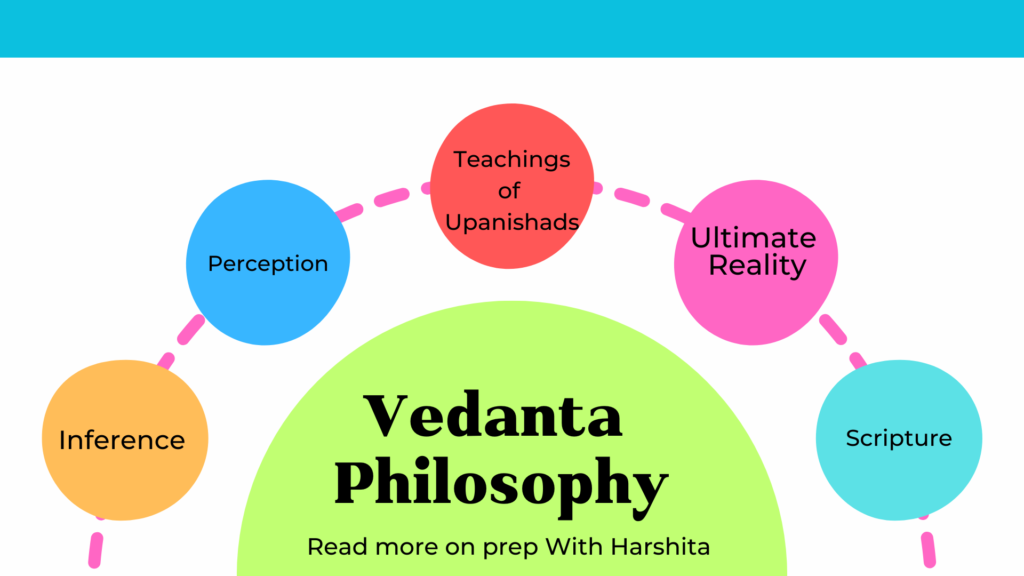
Vedanta Philosophy is a school of Hindu philosophy that is based on the teachings of the Upanishads, which are considered to be the concluding portions of the Vedas, the oldest and most revered scriptures of Hinduism.

The word “Vedanta” literally means “end of the Vedas.”

Vedanta philosophy is centered around the idea of the ultimate reality, which is called Brahman. Brahman is considered to be the unchanging, eternal, and infinite reality that underlies all of creation. According to Vedanta, the ultimate goal of human life is to realize this ultimate reality and to become one with it.

Three main Schools of Vedanta Philosophy :

There are three main schools of Vedanta philosophy: Advaita Vedanta, Vishishtadvaita Vedanta, and Dvaita Vedanta.

Advaita Vedanta, which was founded by the 8th-century philosopher Adi Shankara, holds that Brahman is the only reality and that everything else, including the individual self (Atman), is an illusion. According to this school, the goal of human life is to realize this ultimate reality and to transcend the illusion of individual existence.

Vishishtadvaita Vedanta, which was founded by the 11th-century philosopher Ramanuja, holds that Brahman is the ultimate reality, but that the individual self is also real and distinct from Brahman. According to this school, the goal of human life is to realize the unity between the individual self and Brahman.

Dvaita Vedanta, which was founded by the 13th-century philosopher Madhva, holds that both Brahman and the individual self are real and distinct entities. According to this school, the ultimate goal of human life is to attain devotion to God and to attain eternal life in the presence of God.

Overall, Vedanta philosophy has had a profound impact on Indian culture and has influenced many spiritual traditions both within and outside of India.

Epistemology of Vedanta Philosophy:

Epistemology is the branch of philosophy that deals with knowledge and belief.

In Vedanta philosophy, epistemology is closely tied to the concept of ultimate reality, or Brahman.

According to Vedanta, there are three means of knowledge or pramanas:

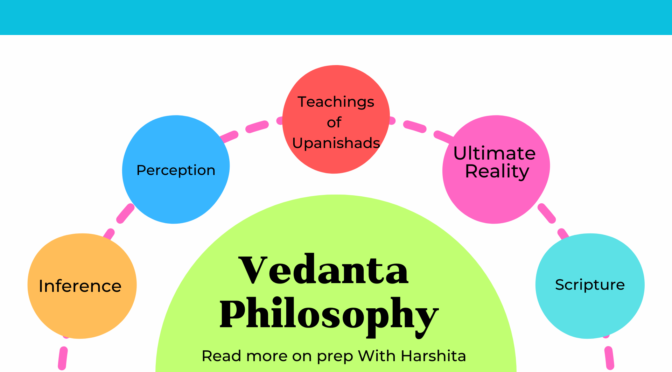
Perception inference, and scripture. Perception refers to direct observation through the senses, inference refers to logical reasoning, and scripture refers to the Vedas and other sacred texts.

However, Vedanta holds that these means of knowledge are limited and cannot provide true knowledge of ultimate reality. Instead, the only way to know Brahman is through direct experience, which is achieved through spiritual practice such as meditation, contemplation, and devotion.

Vedanta also acknowledges the limitations of language and concepts in describing ultimate reality. Brahman is beyond all dualities and cannot be fully described or understood through language or thought.

Therefore, Vedanta places a great emphasis on personal experience and realization of ultimate reality, rather than mere intellectual understanding. The goal of Vedanta is not simply to accumulate knowledge, but to transcend the limitations of the mind and attain direct experience of the ultimate reality.

Also Read : Sankhya Philosophy

Vedanta Philosophy

Also Visit: Prep with Harshita

Sankhya Philosophy

Sankhya Philosophy is one of the six major schools of Indian philosophy, and it focuses on the nature of existence and the process of creation. The Sankhya school was founded by the sage Kapila, who is considered the founder of the school.

Key concepts and principles of Sankhya philosophy include:

  1. Prakriti and Purusha: According to Sankhya philosophy, the universe is composed of two fundamental realities: prakriti (matter) and purusha (spirit). Prakriti is the material world. It is made up of the five elements (earth, water, fire, air, and ether), as well as the mind and the senses. Purusha, on the other hand, is the individual consciousness or soul, which is eternal and unchanging.
  2. Gunas: Prakriti is further divided into three gunas, or qualities: sattva (purity), rajas (activity), and tamas (inertia). These three gunas are responsible for the diversity and complexity of the material world.
  3. Evolution of the Universe: According to Sankhya philosophy, the universe evolves through a process of transformation and combination of the three gunas. This process leads to the formation of the various elements and forms of matter that make up the material world.
  4. Liberation: The ultimate goal of Sankhya philosophy is to achieve liberation (moksha) from the cycle of birth and death. This is achieved through the realization of the true nature of the self (purusha) and the attainment of spiritual knowledge.
  5. Yoga: Sankhya philosophy is closely associated with the practice of yoga, which is seen as a means of attaining spiritual realization and liberation. Yoga is seen as a way of purifying the mind and body. Also, a way of developing the power of concentration and insight.

Overall, Sankhya philosophy provides a comprehensive understanding of the nature of reality and the process of creation, and offers a practical path for achieving spiritual realization and liberation.

Epistemology of Sankhya Philosophies

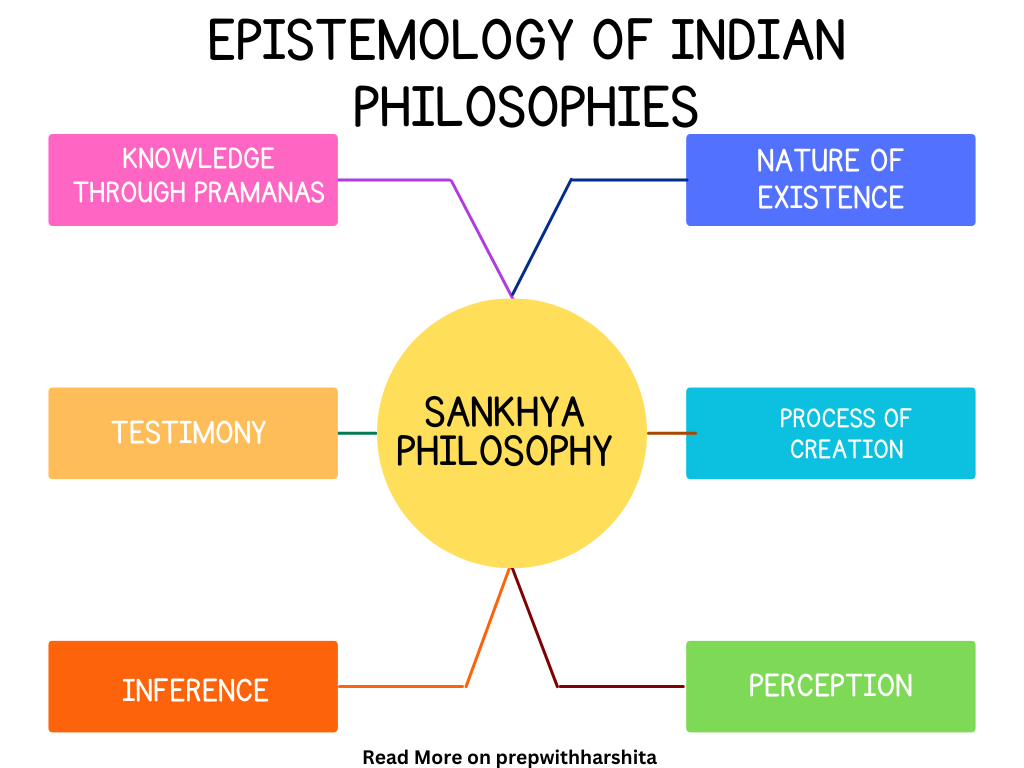
Epistemology is the branch of philosophy that deals with the nature, sources, and limits of knowledge. In Sankhya philosophy, the theory of knowledge (pramana) is an important aspect of epistemology. According to Sankhya philosophy, knowledge is obtained through three pramanas or valid means of knowledge, which are:

  1. Perception (pratyaksha): Perception is the direct knowledge obtained through the senses. It is considered a valid source of knowledge as long as the senses are not impaired and the object is present.
  2. Inference (anumana): Inference is the indirect knowledge obtained through reasoning. It involves drawing a conclusion based on observation and prior knowledge. Inference is considered a valid source of knowledge as long as it is based on reliable premises and the conclusion is logically sound.
  3. Testimony (shabda): Testimony is the knowledge obtained through reliable sources such as scriptures, gurus, and experts. Testimony is considered a valid source of knowledge as long as the source is trustworthy. Also, the knowledge is not contradicted by other valid means of knowledge.

In addition to these three pramanas, this philosophy also recognizes two types of false knowledge (viparyaya): mistaking the impermanent for the permanent and mistaking the impure for the pure.

Overall, Sankhya philosophy provides an understanding of the sources and limits of knowledge. It also emphasizes on the importance of relying on reliable means of knowledge to obtain true and accurate knowledge.

Also Read: Concrete and Absolute Knowledge

Sankhya Philosophy

Also Visit: Prep with Harshita

Make your learning journey easy and much interesting