Tag Archives: b ed notes

Kohlberg’s Theory of Moral Development

Lawrence Kohlberg was a psychologist who proposed a theory of moral development in the 1950s and 60s. Kohlberg’s theory suggests that moral reasoning develops through stages as individuals encounter more complex moral dilemmas throughout their lives.

Levels of Kohlberg’s Theory of Moral Development

Kohlberg identified three levels of moral development, each with two stages, making a total of six stages of moral development:

Level 1: Pre-Conventional Morality

  • Stage 1: Obedience and Punishment Orientation
  • Stage 2: Individualism and Exchange

In the pre-conventional stage, children’s moral reasoning is based on avoiding punishment and seeking rewards. They focus on their own self-interests and do not consider the needs or perspectives of others.

Level 2: Conventional Morality

  • Stage 3: Interpersonal Relationships and Good Intentions
  • Stage 4: Maintaining Social Order

In the conventional stage, individuals are motivated to conform to the expectations of society and maintain social order. Moral reasoning is based on relationships with others and following social rules.

Level 3: Post-Conventional Morality

  • Stage 5: Social Contract and Individual Rights
  • Stage 6: Universal Principles
Also Visit: Prep with Harshita

In the post-conventional stage, individuals develop their own moral principles based on ethical principles and justice. Moral reasoning is based on respect for individual rights and a commitment to justice and equality.

Kohlberg believed that individuals progress through these stages sequentially, and that not everyone reaches the highest level of moral reasoning. He also recognized that individuals may face conflicts between their moral principles and the laws or norms of society.

Critics of Kohlberg’s theory argue that it is culturally biased and that it places too much emphasis on abstract reasoning rather than actual behavior. Despite these criticisms, Kohlberg’s theory has had a significant impact on the field of moral psychology and continues to be studied and debated today.

Read More on: Assessment Techniques of Personality

Meaning and Need of Inclusive Education

Inclusive education refers to an educational approach that aims to provide equitable and quality education to all students, regardless of their abilities, disabilities, gender, ethnicity, social class, and cultural background.

In other words, inclusive education is about creating a learning environment where every student feels valued, respected, and supported to achieve their full potential.

Meaning and Need of Inclusive Education

The need for inclusive education arises from the fact that every student is unique and has their own strengths, challenges, and learning styles. By adopting an inclusive approach, schools and educators can ensure that every student receives the necessary support and resources to overcome barriers to learning and succeed academically, socially, and emotionally. Additionally, inclusive education can promote social cohesion, reduce discrimination, and foster a more tolerant and accepting society.

Also read: Concrete and Absolute Knowledge

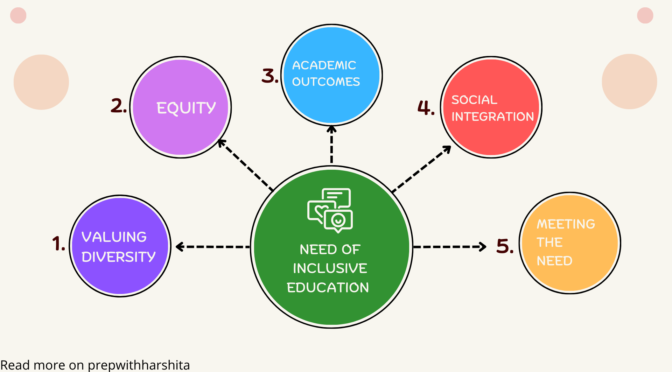
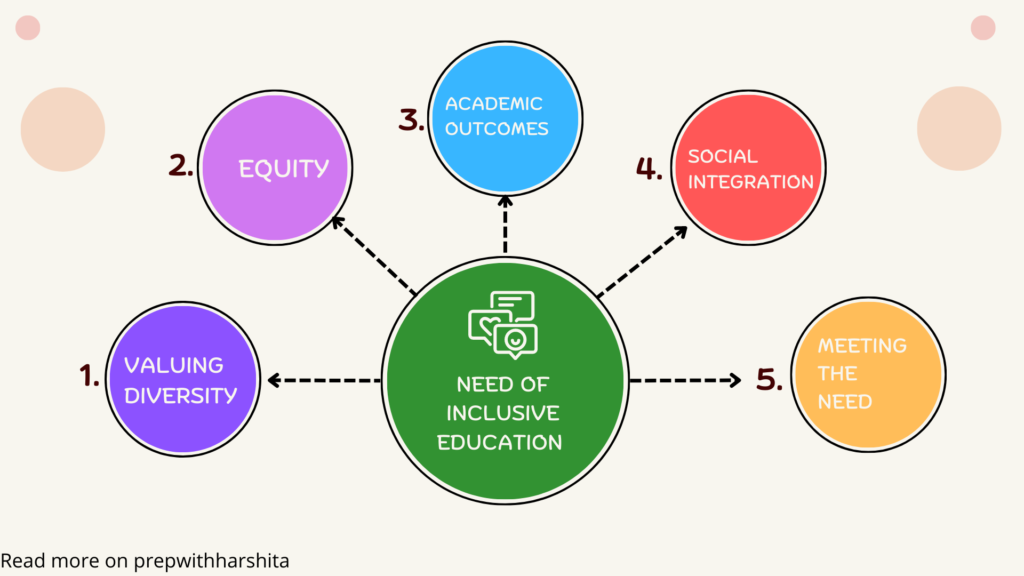
Here are some main points on why we need inclusive education:

  1. Equity and fairness: Inclusive education aims to provide equal educational opportunities to all students, regardless of their background, abilities, or disabilities. It is a fair and just approach that promotes equity and eliminates discrimination.
  2. Valuing diversity: Inclusive education recognizes and celebrates diversity in all its forms, including differences in culture, language, ethnicity, race, gender, sexual orientation, and abilities. It promotes respect for all individuals and their unique contributions to society.
  3. Meeting the needs of all learners: Inclusive education seeks to accommodate the needs of all learners, including those with disabilities or learning difficulties. It provides a supportive learning environment that encourages students to participate and succeed in their education.
  4. Promoting social integration: Inclusive education helps to break down barriers between different groups of students, promoting social integration and creating a sense of belonging. This helps to reduce stereotypes, prejudice, and discrimination.
  5. Improving academic outcomes: Inclusive education has been shown to improve academic outcomes for all students, not just those with disabilities or learning difficulties. It fosters a positive and supportive learning environment that can enhance motivation, engagement, and achievement.
  6. Meeting legal and ethical obligations: Inclusive education is a legal and ethical obligation for schools and educational institutions. It is required by law in many countries and is in line with the United Nations Convention on the Rights of Persons with Disabilities.

Overall, inclusive education is essential for creating a fair, just, and equitable society that values diversity and promotes the well-being and success of all its members.

Also Visit: Prep with Harshita

Flexibility in Examination

The purpose of flexibility in the examination is to provide students with the opportunity to demonstrate their knowledge and skills in a way that is more aligned with their strengths and abilities. This can help to reduce stress and anxiety for students, promote a more inclusive and equitable learning environment, and ensure that students are able to perform to the best of their abilities.

Benefits of Flexibility in Examination

Flexibility in the examination can also benefit students with disabilities or learning differences, who may require accommodations such as extra time or alternative exam formats to fully demonstrate their knowledge and abilities. Providing these accommodations can help to level the playing field and ensure that all students have an equal opportunity to succeed.

Also Read: Socio-Metric Technique

Some features of flexibility in the examination include:

  1. Alternative exam formats: This can include options such as oral exams, take-home exams, or open-book exams, which allow students to demonstrate their knowledge in different ways.
  2. Accommodations for disabilities: Students with disabilities or learning differences may require accommodations such as extra time, specialized equipment, or a quiet testing environment to fully demonstrate their knowledge and abilities.
  3. Rescheduling options: In some cases, students may require flexibility in their exam schedules due to personal circumstances, such as illness, family emergencies, or other unforeseen events.
  4. Clear policies and procedures: Institutions should have clear policies and procedures in place to ensure that students are aware of their options for flexibility in examination and know how to request accommodations or rescheduling.
  5. Consistent standards and rigor: While providing flexibility , institutions must ensure that academic standards and rigor are maintained and that students are held to the same standards of performance regardless of the exam format or accommodations.

Overall, the purpose of flexibility in the examination is to promote fairness, equity, and student success, while also ensuring that academic standards are maintained. By providing options and accommodations, institutions can help to support the diverse needs of their student populations and promote a more inclusive learning environment.

Flexibility in Examination
Also Visit: Prep with Harshita

Attitude Scale

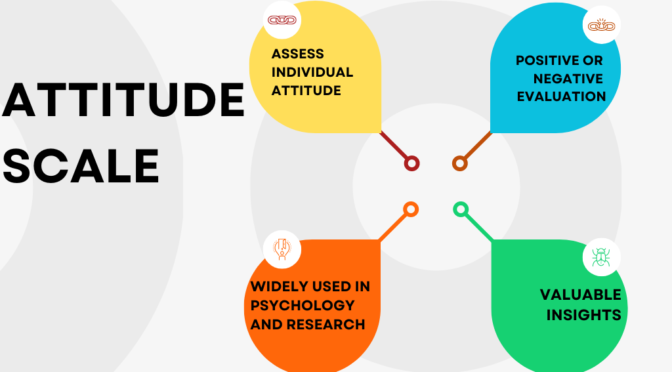
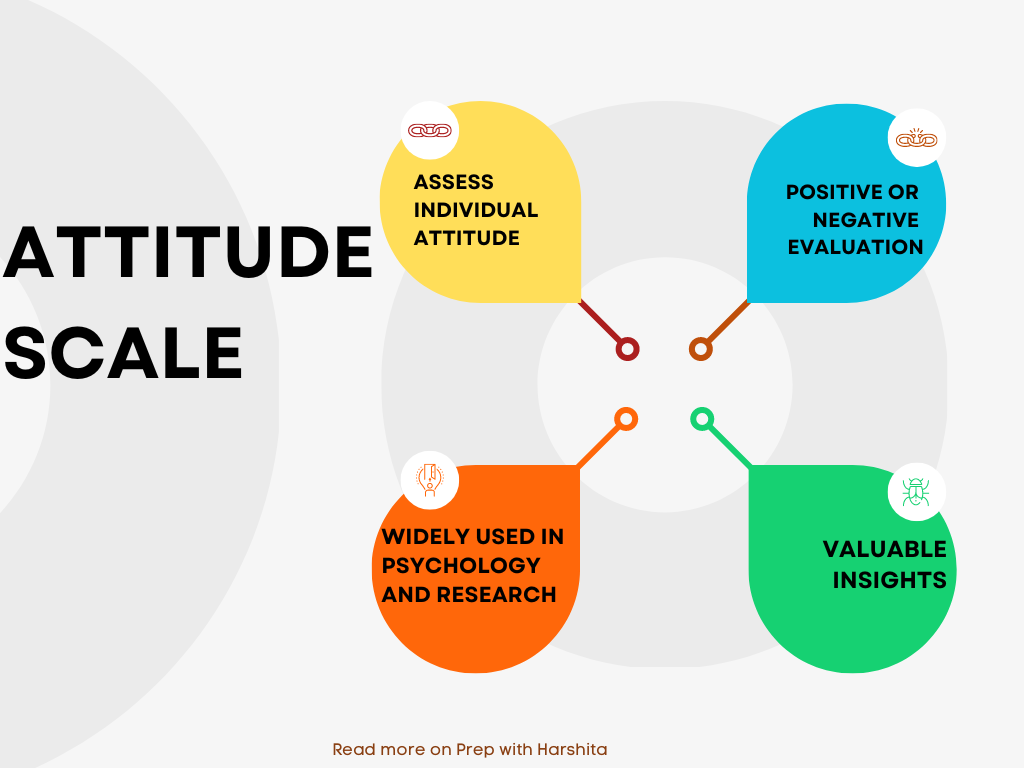
An attitude scale is a measurement tool used in psychology and social sciences to assess an individual’s attitude toward a particular object, concept, or event. Attitudes refer to the positive or negative evaluations, feelings, or beliefs that individuals hold towards an object or issue. Attitude scales typically consist of a series of statements or questions that measure the strength and direction of an individual’s attitude toward a particular subject.

There are different types of attitude scales, such as Likert scales, semantic differential scales, and Thurstone scales. Likert scales are the most commonly used type of attitude scale, and they ask respondents to rate their level of agreement or disagreement with a series of statements on a numeric scale, usually ranging from 1 to 5 or 1 to 7.

Attitude scales are widely used in research studies to measure people’s attitudes toward a variety of subjects, including political issues, social problems, health behaviors, and consumer products. The data collected from attitude scales can provide valuable insights into people’s beliefs, perceptions, and intentions, and can be used to develop effective interventions or communication strategies.

Also Visit: Prep with Harshita

There are several benefits of using attitude scales to measure individuals’ attitudes toward specific objects or issues:

  1. Standardization: Attitude scales provide standardized measures that allow researchers to compare attitudes across different groups of people and over time.
  2. Accuracy: Attitude scales provide a more accurate and reliable measurement of attitudes compared to other methods such as interviews or observations.
  3. Precision: Attitude scales can capture even subtle differences in attitudes that might be missed through other means of measurement.
  4. Objectivity: Attitude scales are less prone to subjective interpretation by researchers, which can lead to more objective and unbiased data.
  5. Efficiency: Attitude scales are a quick and efficient way to gather data from large numbers of participants.
  6. Predictive power: Attitude scales can be used to predict behavior, as attitudes are often a good predictor of future behavior.

Overall, attitude scales are a useful tool for researchers to better understand individuals’ attitudes towards different objects or issues and to gain insights into potential behaviors or decision-making processes.

Attitude Scale
Also Read: Rating Scale

Anecdotal Records

An anecdotal record is a form of documentation that is used in educational settings to record and track the progress of a student’s learning and development. It involves writing down observations and notes about a student’s behaviors, actions, and interactions in a naturalistic setting. These records are typically written in a narrative form and are based on the teacher’s subjective observations.

Anecdotal records can be useful for a variety of reasons, such as providing evidence of progress or identifying areas of concern that may require additional support or intervention. They can also be used to communicate with parents or other educators about a student’s progress.

Anecdotal records are typically kept over a period of time and may include information about a student’s academic performance, social interactions, and emotional well-being. They can be used in conjunction with other forms of assessment, such as standardized tests or performance-based assessments, to provide a more complete picture of a student’s progress.

Also Read: Rating Scale

Here are some specific ways in which anecdotal records can be useful:

  1. Identify student strengths and areas of improvement: Anecdotal records can provide insights into a student’s strengths and areas for improvement. By observing and documenting a student’s behaviors, actions, and interactions, teachers can identify areas in which a student is excelling and areas that require additional support.
  2. Monitor progress: Anecdotal records can be used to track a student’s progress over time. This can be especially useful for students with learning difficulties or behavioral issues.
  3. Inform lesson planning: It can inform lesson planning by providing information about a student’s learning style, interests, and abilities. This can help teachers tailor their lessons to better meet the needs of individual students.
  4. Communicate with parents: Anecdotal records can be used to communicate with parents about their child’s progress. By sharing observations and notes with parents, teachers can provide a more complete picture of their child’s performance and development.
  5. Evaluate program effectiveness: It can be used to evaluate the effectiveness of educational programs or interventions. By comparing the progress of students who received a specific intervention to those who did not, teachers can determine whether the intervention was successful.
Also Visit: Prep with Harshita