In-service teacher training refers to professional development programs and activities designed for teachers who are already employed and actively teaching in schools. These programs aim to enhance teachers’ knowledge, skills, and instructional practices, keeping them updated with the latest research and pedagogical approaches.
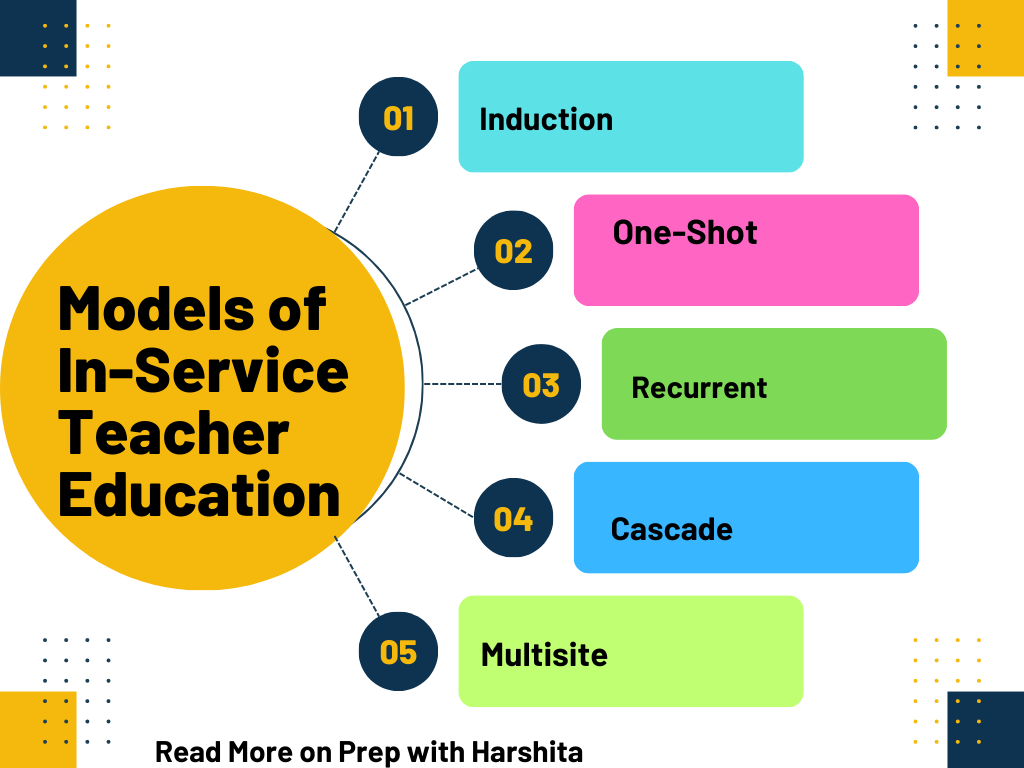
There are several models of in-service teacher training that educational institutions and organizations employ. Here are a few common models:
Induction: Induction programs are designed for newly hired teachers to help them transition smoothly into their teaching roles. These programs typically last for a specific period, such as one or two years, and provide support and mentorship to novice teachers. The focus is on familiarizing them with school policies, curriculum, instructional strategies, and classroom management techniques. Induction programs aim to build a strong foundation for new teachers and help them develop the necessary skills and confidence for effective teaching.
One-shot: The one-shot model of in-service teacher training involves a single, isolated training session or workshop. It is usually a short-duration program that addresses a specific topic or skill. The training session may be conducted by an expert in the field or a resource person who specializes in the area being addressed. The one-shot model provides a targeted learning experience on a particular theme or strategy, but it may not allow for extensive follow-up or ongoing support.
Recurrent: Recurrent in-service teacher training programs are characterized by regular and periodic training sessions conducted throughout the year. These programs aim to provide continuous professional development opportunities to teachers. The sessions can be conducted weekly, monthly, or at specific intervals, depending on the needs of the teachers and the organization. Recurrent training allows for more sustained and ongoing support, ensuring that teachers have the opportunity to deepen their knowledge and skills gradually.
Cascade: Cascade training, also known as train-the-trainer model, involves training a group of educators who then become trainers themselves. The initial training is provided to a select group of teachers or educational leaders who possess expertise in a particular area. These trained individuals then disseminate the knowledge and skills to their colleagues or subordinates within the organization. Cascade training is effective for large-scale training initiatives, as it allows for the efficient distribution of knowledge across multiple levels within the educational system.
Multisite: Multisite in-service teacher training involves collaborative efforts among multiple schools or educational institutions. This model brings together teachers from different locations or districts to participate in joint training programs. It promotes networking, sharing of best practices, and cross-pollination of ideas among educators from various contexts. Multisite training programs often involve workshops, conferences, or professional learning communities that enable teachers to connect and collaborate with peers from different schools.
School-based: School-based in-service teacher training focuses on professional development activities conducted within the school or district. These programs are tailored to meet the specific needs and goals of the school community. School-based training can include various approaches, such as teacher-led workshops, lesson observations, collaborative planning sessions, peer coaching, or action research projects. The advantage of this model is that it aligns professional development with the specific context and priorities of the school, fostering a sense of ownership and relevance among teachers.
Coursework: Coursework-based in-service teacher training involves enrolling in formal courses or academic programs offered by universities or educational institutes. These courses are often part-time or online, allowing teachers to continue their professional development while working. Coursework may cover a wide range of topics, including pedagogy, subject-specific content, assessment strategies, special education, or educational leadership. The coursework model provides a structured and systematic approach to professional development, offering theoretical knowledge and practical application opportunities.
It’s important to note that these models are not mutually exclusive and can be combined or adapted based on the specific needs and resources of an educational institution or organization. The choice of model depends on factors such as the goals of the training program, available resources, time constraints, and the preferences of the teachers and administrators involved.
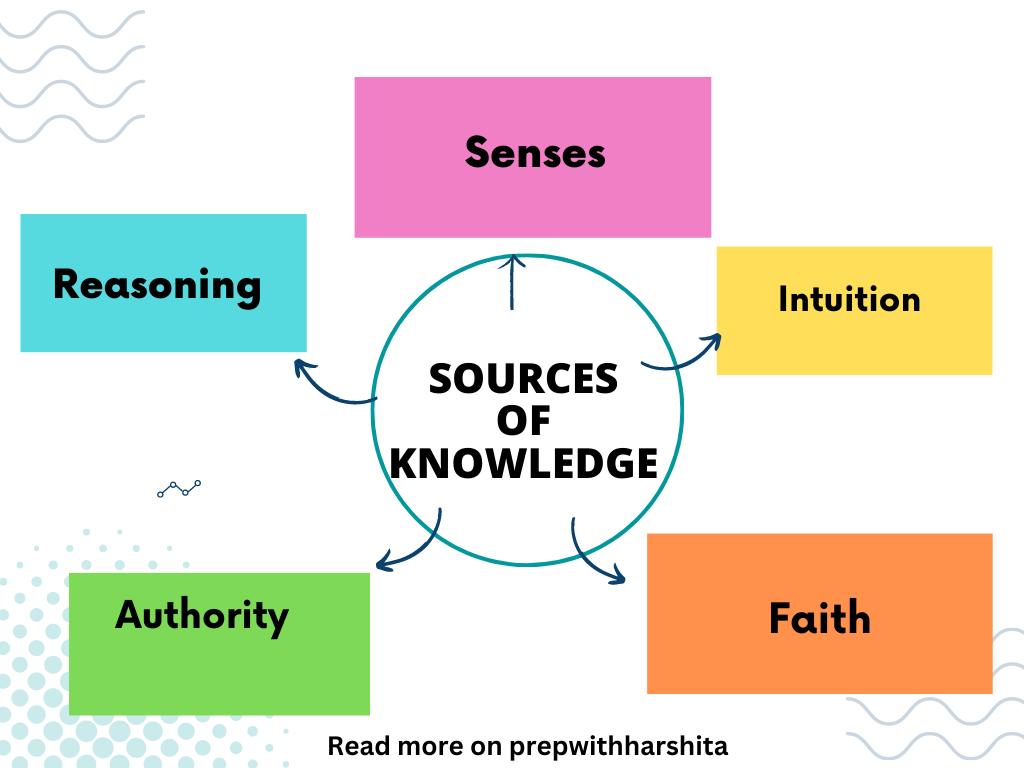
Sources of knowledge can be categorized into several main types, including sense experience, faith, authority, reason, intuition, and revelation. Each of these sources offers a unique perspective on acquiring knowledge.
Here’s a brief explanation of each:
Sense Experience: Sense experience is the most fundamental source of knowledge. It involves gathering information through our five senses—sight, hearing, touch, taste, and smell. This type of knowledge is based on direct observation and interaction with the world around us. For example, seeing a rainbow, feeling the warmth of a fire, or tasting a ripe fruit are all examples of knowledge gained through sense experience.
Faith: Faith is a source of knowledge that relies on belief and trust in something without empirical evidence or logical proof. It often involves religious or spiritual beliefs but can extend beyond that as well. Faith provides individuals with a framework for understanding the world, answering existential questions, and guiding their moral values and behaviors. It can offer knowledge about the meaning of life, the existence of a higher power, or the nature of the divine.
Authority: Authority as a source of knowledge involves relying on the expertise and credibility of others who possess specialized knowledge or experience in a particular field. This can include experts, professionals, scholars, or individuals in positions of authority. Authority can provide knowledge by consulting reliable sources, such as academic research, expert opinions, or trusted publications. We often turn to authority when we lack personal expertise or when the information is beyond our direct experience.
Reason: Reason is the use of logical and rational thinking to acquire knowledge. It involves critical thinking, deductive and inductive reasoning, and evaluating evidence and arguments. Reasoning allows us to analyze information, draw logical conclusions, and make informed judgments. Through reason, we can identify cause-and-effect relationships, recognize patterns, and make logical deductions. Reasoning is crucial in scientific inquiry, problem-solving, and decision-making.
Intuition: Intuition is a source of knowledge that relies on instinctive or “gut” feelings without conscious reasoning or evidence. It involves a deep understanding or insight gained without apparent logical processes. Intuition is often associated with subconscious information processing and drawing on past experiences. It can manifest as a “hunch” or an immediate understanding of a situation without being able to articulate why. While intuition can be influential in decision-making, it is subjective and can vary between individuals.Intuitions sometimes conflict.
Revelation: Revelation refers to knowledge that is believed to be revealed by a divine or supernatural source. It is often associated with religious or spiritual experiences in which individuals claim to receive direct communication or insight from a higher power. Revelation can provide profound insights into religious doctrines, moral principles, or metaphysical truths. However, it is subjective and personal, relying on individual experiences or claims of divine intervention. This source has the same problem as intuition. Sometimes one claims to know something by means of revelation. For example, “It was revealed to me in a dream” (or a vision).
It’s worth noting that these sources of knowledge are not mutually exclusive, and they can interact and complement each other. For example, scientific discoveries may be based on both sense experience and reason, while religious beliefs may incorporate elements of faith and revelation. Critical thinking and evaluating evidence are important for assessing the reliability and validity of knowledge gained through these various sources.
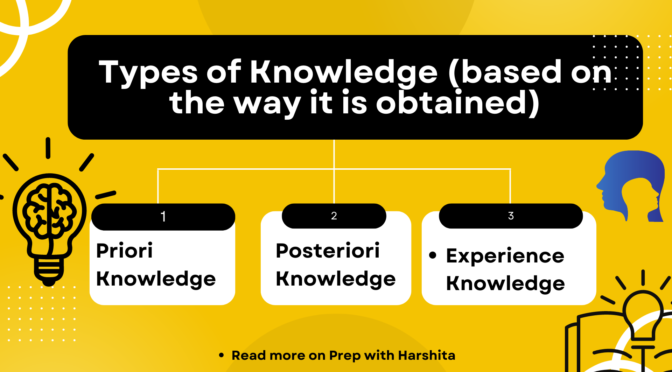
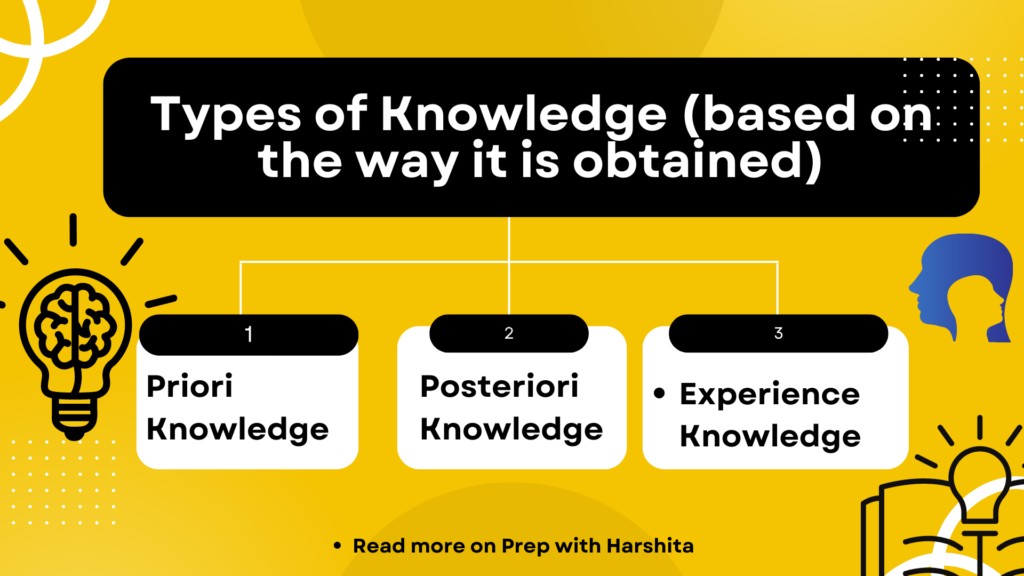
There are many types of knowledge. Based on the way, knowledge is obtained; it can be classified under three parts.
Types of Knowledge :
Posteriori Knowledge: Posteriori knowledge, also known as empirical knowledge or knowledge “from experience,” refers to knowledge that is gained through direct observation, experience, or empirical evidence. It is based on information obtained through the senses or through the collection and analysis of data. Posteriori knowledge is specific to particular instances or observations and is often contingent on the context in which it is acquired. For example, knowing that water boils at 100 degrees Celsius is posteriori knowledge because it is derived from observations and experiments.
Priori Knowledge: Priori knowledge, also known as a priori knowledge or knowledge “prior to experience,” refers to knowledge that is independent of empirical evidence or sensory experience. It is based on reasoning, deduction, and logical analysis. Priori knowledge is considered to be universal and necessary, meaning it holds true in all possible instances. It is not contingent on particular observations or specific experiences. For example, knowing that all bachelors are unmarried is a priori knowledge because it is based on the definition of the term “bachelor” and does not require empirical verification.
Experiential Knowledge: Experiential knowledge, also known as practical knowledge or knowledge “by experience,” is the knowledge that is gained through direct personal involvement and engagement with the world. It is acquired through hands-on experiences, experimentation, and reflective practice. Experiential knowledge is often subjective and context-dependent, influenced by individual perceptions, emotions, and interpretations. It is deeply rooted in personal experiences, including both successes and failures, and can be tacit or difficult to articulate explicitly. For example, a surgeon’s knowledge of surgical techniques and procedures is largely based on experiential knowledge gained through years of practice and actual surgeries.
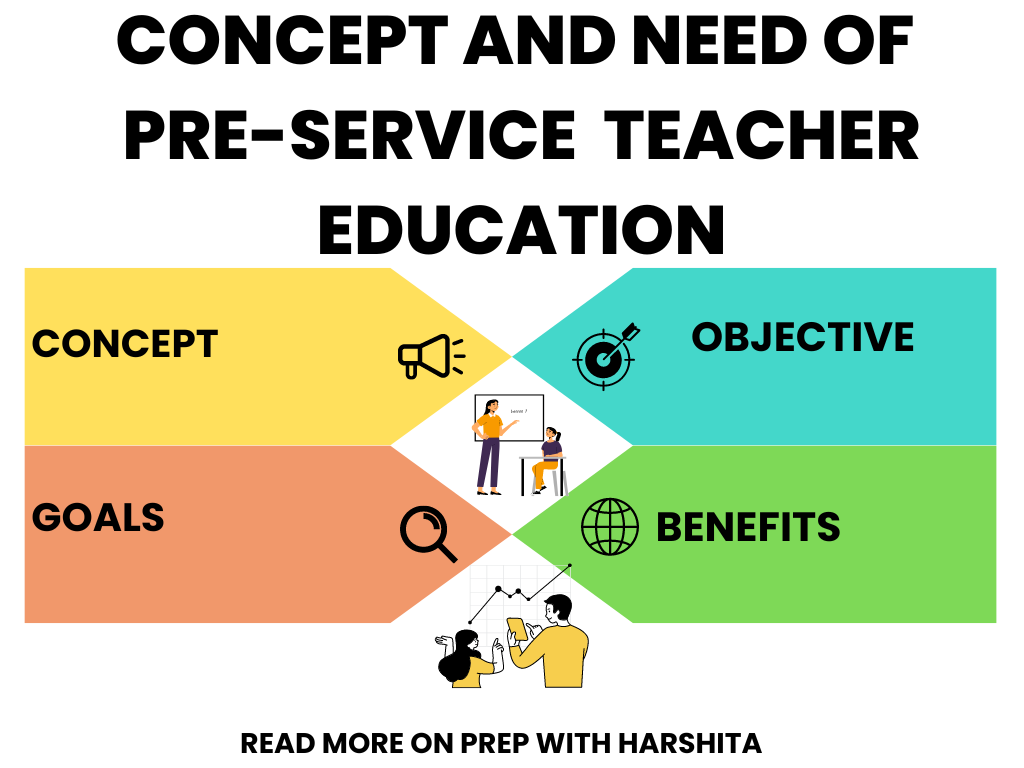
Pre-service teacher education refers to the formal training and educational programs that individuals undergo before they begin their careers as licensed or certified teachers.
Concept of Pre-Service Teacher Education
It is the phase of education that prospective teachers go through to acquire the necessary knowledge, skills, and competencies to become effective educators.
Pre-service teacher education is typically completed at universities, colleges, or teacher training institutes and is designed to prepare individuals for the demands and responsibilities of the teaching profession.
During pre-service teacher education, prospective teachers engage in a structured curriculum that covers various aspects of education, including pedagogy, subject knowledge, classroom management, assessment strategies, educational psychology, and teaching methods. The curriculum is designed to provide a comprehensive understanding of the principles, theories, and practices of education, as well as the specific knowledge and skills related to the subject(s) the prospective teachers will teach.
In addition to theoretical knowledge, pre-service teacher education often includes practical components such as teaching practicums, internships, or student teaching placements. These practical experiences allow prospective teachers to apply their knowledge in real classroom settings, under the guidance and supervision of experienced educators. By actively engaging in teaching practice during pre-service education, prospective teachers gain valuable hands-on experience, develop instructional strategies, and acquire the necessary skills to effectively facilitate student learning.
Need for Pre-Service Teacher Education:
The need for pre-service teacher education arises from several key factors and considerations.
Here are some of the reasons why pre-service teacher education is essential:
Professional Preparation: Pre-service teacher education provides aspiring teachers with the necessary knowledge, skills, and competencies to excel in their profession. It offers a structured and comprehensive curriculum that covers various aspects of education, including pedagogy, subject knowledge, classroom management, assessment strategies, and educational psychology. Through pre-service education, prospective teachers gain a solid foundation that prepares them to meet the demands and challenges of the teaching profession.
Pedagogical Training: Pre-service education equips future teachers with pedagogical knowledge and teaching strategies that have been researched, tested, and proven effective. It introduces prospective teachers to different instructional methods, assessment techniques, and classroom management strategies that support student learning and engagement. By acquiring pedagogical training during pre-service education, teachers are better equipped to create effective and inclusive learning environments for their students.
Subject Content Mastery: Pre-service teacher education programs focus on developing prospective teachers’ subject knowledge in the areas they intend to teach. This deep understanding of subject matter enables teachers to deliver accurate and meaningful instruction, respond to students’ questions, and provide appropriate guidance. By enhancing subject content mastery, pre-service education ensures that teachers are equipped to provide a solid foundation of knowledge to their students.
Classroom Readiness: Pre-service teacher education includes practical experiences such as teaching practicums, internships, or student teaching placements. These experiences allow prospective teachers to gain firsthand experience in real classroom settings, under the guidance and supervision of experienced educators. By actively engaging in teaching practice during pre-service education, prospective teachers become familiar with the dynamics of the classroom, develop instructional strategies, manage student behavior, and build confidence in their abilities to effectively facilitate student learning.
Understanding of Learner Diversity: Pre-service teacher education emphasizes the importance of recognizing and addressing learner diversity. Prospective teachers are introduced to concepts related to inclusive education, differentiated instruction, and supporting the needs of diverse learners, including students with disabilities, English language learners, or students from diverse cultural backgrounds. Pre-service education equips teachers with the knowledge and strategies to create inclusive and supportive learning environments where all students can thrive.
Professional Ethics and Standards: Pre-service teacher education promotes the development of professional ethics, values, and standards in future teachers. It emphasizes the importance of ethical conduct, respecting student rights, maintaining professional relationships, and upholding the principles of fairness and equity. Pre-service education instills a sense of professional responsibility and prepares teachers to navigate ethical dilemmas and make informed decisions in their practice.
Continuous Improvement and Lifelong Learning: Pre-service teacher education encourages prospective teachers to embrace the concept of lifelong learning and continuous professional development. It fosters a culture of reflection, self-assessment, and ongoing learning, where teachers are motivated to enhance their teaching practices, stay abreast of research and educational advancements, and continuously improve their instructional approaches throughout their careers.
In summary, pre-service teacher education is essential to provide aspiring teachers with the necessary knowledge, skills, and preparation to enter the teaching profession. It ensures that teachers are well-equipped to meet the diverse needs of students, create effective learning environments, and uphold professional ethics and standards. By investing in pre-service education, the quality of teaching and learning can be enhanced, leading to improved student outcomes and overall educational excellence.
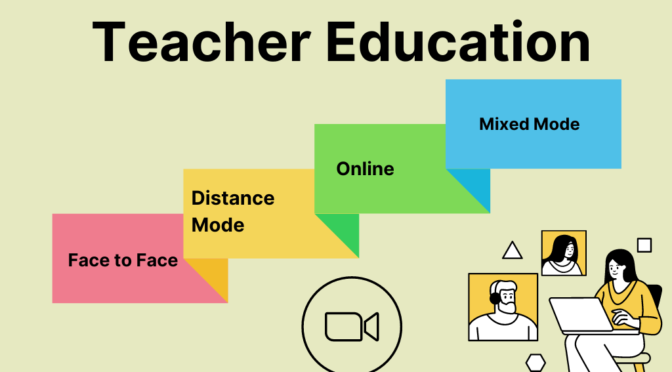
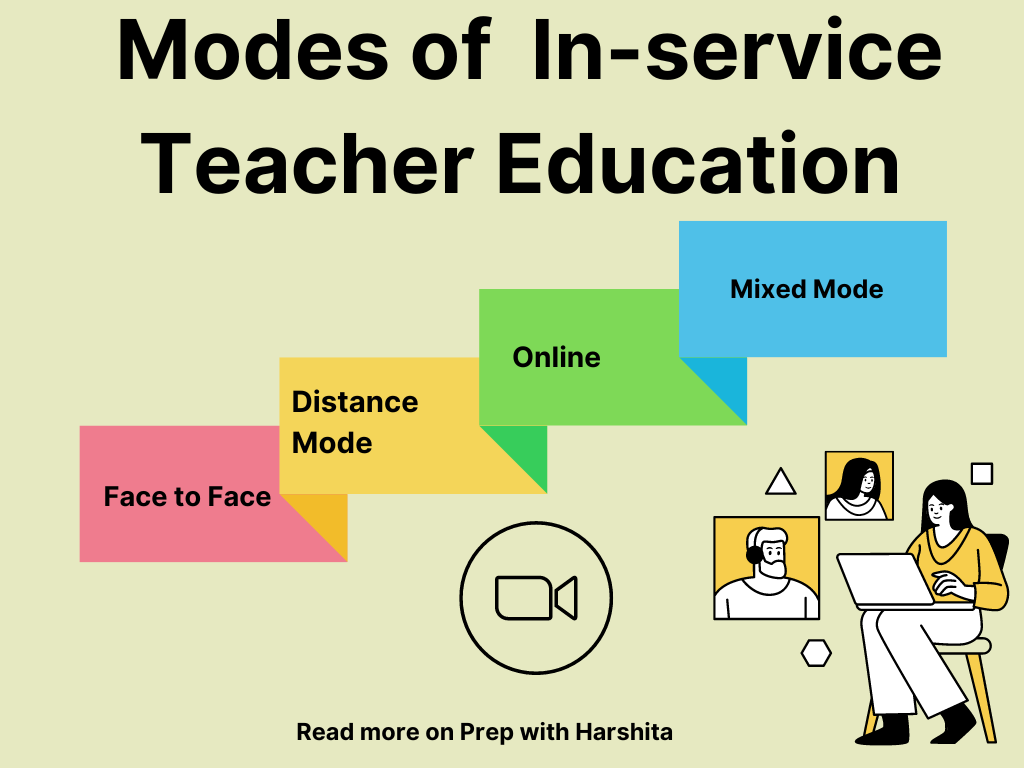
Modes of in-service teacher education refer to the different delivery methods and formats through which professional development and training opportunities are provided to teachers.
Here are some common modes of in-service teacher education:
Face-to-Face Mode: The face-to-face mode of in-service teacher education refers to traditional, in-person training and professional development sessions. These sessions are conducted in physical locations, such as schools, training centers, or conference venues. Teachers attend workshops, seminars, conferences, or training sessions where they interact directly with facilitators, experts, and other participants. Face-to-face mode provides opportunities for immediate feedback, networking, collaboration, and hands-on learning activities. It allows for personal interaction, question-and-answer sessions, and real-time discussions, fostering a sense of community and engagement among participants.
Distance Mode: The distance mode of in-service teacher education involves providing professional development opportunities to teachers who are physically separated from the training provider. In this mode, educational materials, resources, and instructional support are delivered to teachers through various means of communication, such as mail, telephone, or broadcasting. Distance mode can include sending printed materials, recorded lectures, or educational videos to teachers, who can access and study the content at their convenience. Distance mode allows for flexibility in learning, accommodating teachers who may not be able to attend face-to-face sessions due to geographic or scheduling constraints.
Online Mode: Online mode of in-service teacher education utilizes internet-based platforms and tools to deliver professional development opportunities to teachers. This mode involves accessing training materials, courses, webinars, interactive modules, or virtual classrooms through online platforms. Teachers can participate in self-paced learning, collaborate in virtual communities, engage in discussions, complete assignments, and access resources from anywhere at any time. Online mode offers flexibility, allowing teachers to balance their professional development with their existing responsibilities. It also facilitates interaction with educators and experts from around the world through online forums, chats, and video conferencing.
Mixed Mode (Blended Learning): Mixed mode, also known as blended learning, combines elements of face-to-face and online modes of in-service teacher education. In this mode, teachers participate in a combination of in-person sessions and online activities. For example, a workshop or seminar may include both on-site sessions where teachers gather for presentations, group discussions, and hands-on activities, as well as follow-up online components where teachers engage in further discussions, complete assignments, or access supplementary resources. Mixed mode offers the benefits of face-to-face interaction, immediate feedback, and networking, while also providing the flexibility and accessibility of online learning.
Each mode of in-service teacher education has its own advantages and considerations, and the choice of mode depends on various factors such as the goals of the professional development program, the availability of resources and technology, the needs and preferences of the teachers, and the constraints of time and location. Many training programs today adopt a mixed mode approach, combining face-to-face sessions with online components to provide a well-rounded and flexible learning experience for teachers.